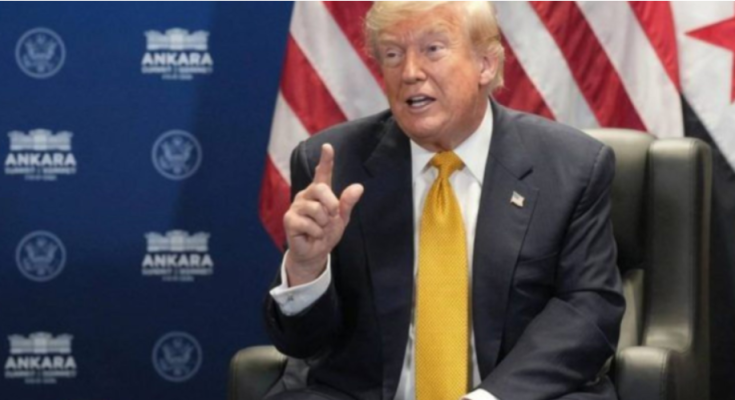
President Donald Trump has issued a stark warning to Iran, declaring that he has left standing instructions for an overwhelming U.S. military response should Iranian actors succeed in assassinating him.
In an interview with the New York Post on July 10, Trump said he has long been Tehran’s top target. “I’ve been on their list for a long time. That’s what we’re dealing with,” he stated. “The only thing is, I’ve left instructions — if anything happens, to just literally bomb them at levels that they’ve never seen before.”
The following day, Trump amplified the message on Truth Social. He wrote that “1,000 Missiles are Locked and Loaded and aimed at the Islamic Republic of Iran, with thousands of more to immediately follow” if the Iranian government acts on its threats to kill him. “Orders have already been given,” he added, “and the U.S. Military is ready, willing, and able… to completely decimate and destroy all areas of Iran.”
The remarks come amid years of elevated tensions following the January 2020 U.S. strike that killed Iranian Quds Force commander Qasem Soleimani. Iranian officials and affiliated groups have repeatedly threatened retaliation against those involved, and U.S. authorities have investigated alleged plots targeting Trump and other American figures. Security around the president has remained heightened as a result.
Trump dismissed reports of a new, specific plot shared by Israeli intelligence, insisting the threat has been continuous rather than newly discovered. “I’ve been No. 1 on Iran’s kill list for a long time, and it’s the way life is,” he said.
The warning also raises questions of presidential succession and authority. Under the Constitution and the Presidential Succession Act, if a sitting president is killed or incapacitated, the vice president immediately assumes the office. Vice President JD Vance would become commander in chief and would hold final authority over any military response. Pre-existing instructions from a previous president do not automatically bind a successor; decisions involving the use of force remain subject to constitutional, statutory, and military constraints at the time.
The broader U.S.-Iran confrontation continues to involve Iran’s nuclear program, regional proxy activity, and periodic military exchanges. Supporters of Trump’s rhetoric argue that clear, public deterrence may discourage an assassination attempt by raising the prospective cost to Tehran. Critics counter that such language risks further escalation between two longtime adversaries already locked in a volatile standoff.
For now, Trump’s message is unambiguous: he wants Iranian leaders to believe that an attack on him would trigger consequences far beyond any single individual. As intelligence agencies monitor potential threats and security officials maintain heightened protections for senior U.S. political figures, any credible development involving Iran and the president’s personal safety would rapidly escalate into a major national-security crisis.