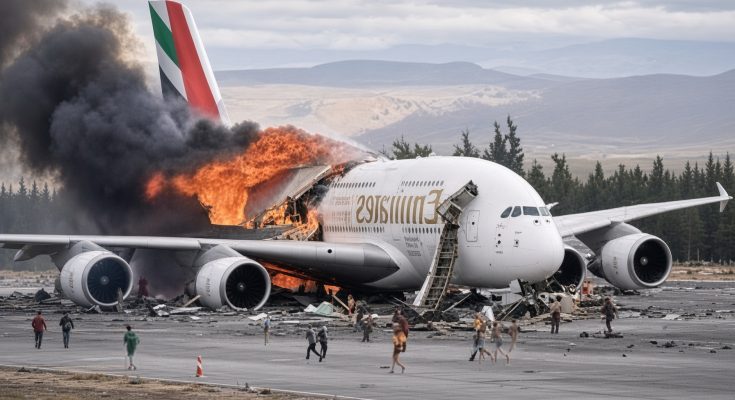
What began as a routine international flight from Thiruvananthapuram, India, to Dubai became one of the most dramatic aviation emergencies in the region when Emirates Flight EK521 crashed during an attempted go-around at Dubai International Airport on August 3, 2016.
The Boeing 777-300 was carrying 282 passengers and 18 crew members when it approached Dubai around midday. At approximately 12:45 p.m. local time, the aircraft attempted to land on Runway 12L. But the approach quickly turned into a desperate fight to regain control.
According to the UAE General Civil Aviation Authority’s investigation, the aircraft had initiated a go-around after an unsuccessful landing attempt. It then descended back onto the runway, sliding for roughly 800 meters before coming to a stop.
🔥 Fire Erupts as Passengers Flee
Within moments, the aircraft was engulfed by fire.
Inside the cabin, passengers and crew faced a rapidly developing emergency as evacuation procedures began. Emergency exits and slides were used, and all 300 people aboard escaped the aircraft before the fire consumed it. Emirates said the rapid response of its crew and Dubai airport emergency teams helped ensure that every passenger and crew member was evacuated safely.
The aircraft itself was ultimately destroyed by the impact and subsequent fire.
The incident also brought a devastating loss. Firefighter Jassim Al Baloushi was killed while responding to the burning aircraft. His death became the only fatality associated with the crash, despite the scale of the disaster.
⚠️ Windshear Played a Role
Early reports focused heavily on windshear and concerns surrounding the landing. The final investigation found that changing wind conditions were among several contributing factors.
The investigation determined that the crew had attempted a go-around, but the engines remained at idle for most of the maneuver. The pilots were unaware that the autothrottle had not responded as expected, leaving the aircraft without sufficient energy to remain airborne. Investigators also identified gaps in the information communicated by air traffic control, including reports of windshear and earlier go-arounds by other aircraft.
The final report also concluded that the crew’s reliance on automation and limited experience with a go-around initiated close to the runway affected performance during the critical moments.
🛫 A Narrow Escape
For the hundreds of passengers aboard EK521, the seconds after the aircraft stopped were a terrifying race against time. Smoke, flames and alarms transformed an ordinary journey into an emergency evacuation.
Yet the outcome could have been far worse.
Every passenger and crew member escaped before the fire destroyed the aircraft. The tragedy instead became a powerful reminder of the importance of crew training, emergency preparedness, communication and rapid decision-making during aviation emergencies.
The loss of firefighter Jassim Al Baloushi remains a solemn part of the story. While 300 people survived the crash, one first responder gave his life while confronting the flames.
Today, EK521 is remembered not only as a major aviation accident, but also as a story of survival—and of the emergency crews who rushed toward danger while everyone else was trying to escape.