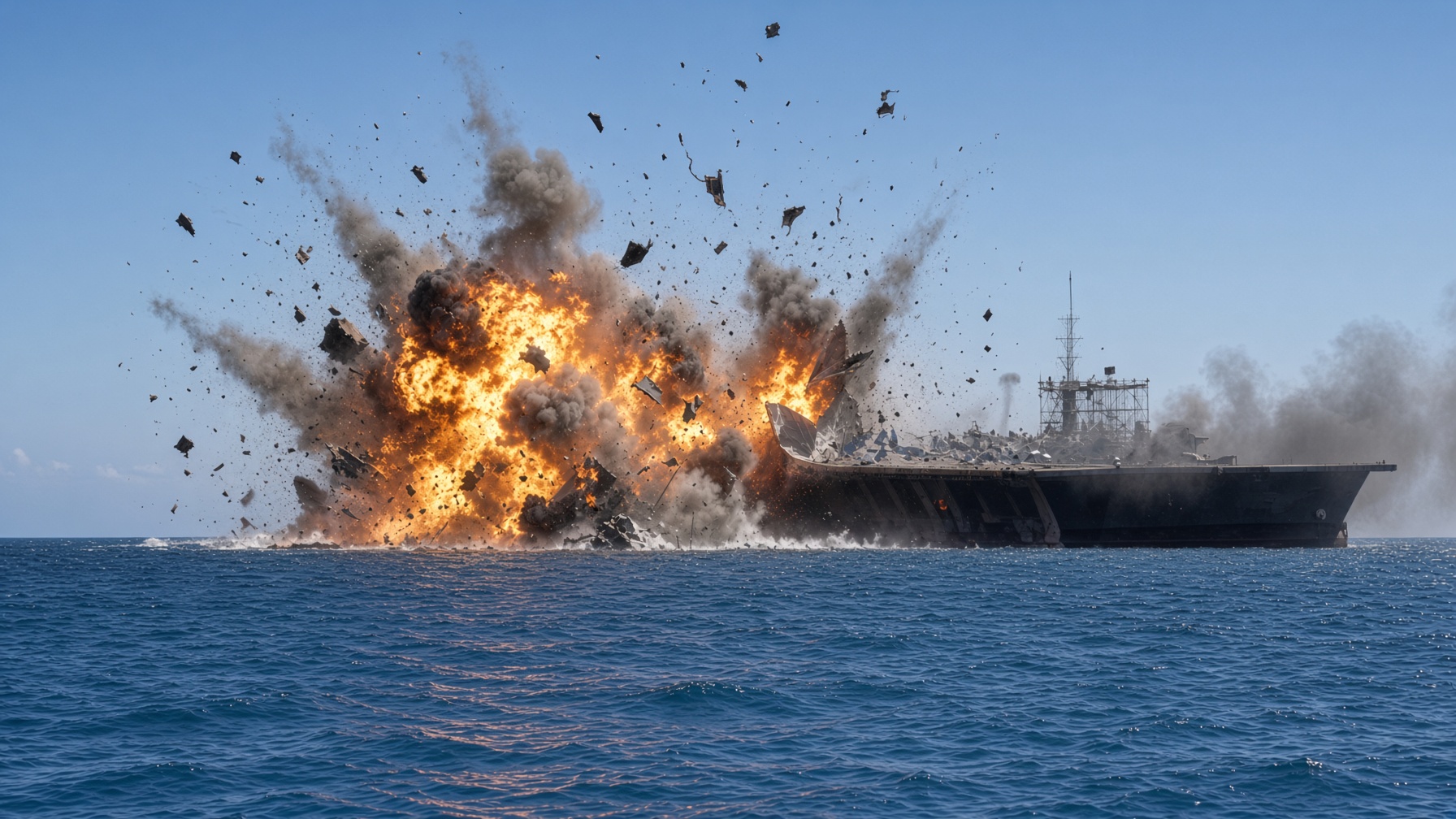
ARABIAN SEA — U.S. forces fired on an Iranian vessel that sailed dangerously close to the aircraft carrier USS Abraham Lincoln, two American officials briefed on the matter told CBS News. The officials spoke on condition of anonymity because they were not authorized to discuss the engagement publicly.
The confrontation unfolded earlier in the week of March 12, 2026, while the Lincoln strike group was operating in the Arabian Sea in support of the U.S. campaign against Iran. A Navy surface ship first tried to engage the approaching vessel with its 5-inch, 54-caliber Mark-45 deck gun, the automated cannon standard on U.S. destroyers and cruisers since the 1970s. The rounds missed several times. Officials did not say whether the shots were intended as warning fire or aimed to hit.
A helicopter armed with Hellfire missiles was then launched and struck the Iranian vessel with two missiles. The condition of the ship and its crew was not known. Officials did not identify the U.S. warship that fired the gun or the helicopter type. Both the Navy’s MH-60R Seahawk and the Marine Corps AH-1Z Viper can carry Hellfires.
The Lincoln was operating with destroyers USS Spruance and USS Michael Murphy. At least six other guided-missile destroyers were also in the Arabian Sea that week. It was not confirmed which escort fired.
CBS asked U.S. Central Command for comment. A defense official replied, “We have nothing for you on this.” The Pentagon issued no public confirmation or denial at the time. Iran had not issued a detailed public response to that specific clash.
The episode fit a pattern of close encounters around the carrier. In early February, CENTCOM said an Iranian Shahed-139 drone “aggressively” approached the Lincoln and maneuvered toward it. A U.S. fighter shot the drone down. The Lincoln strike group had arrived in the region in late January as part of what President Donald Trump called an “armada.” After major operations began, CENTCOM said U.S. forces had damaged or destroyed more than 90 Iranian naval vessels.
The Lincoln was one of two U.S. carriers then in the Middle East. Carriers sit at the center of strike groups built to keep hostile craft away from the flight deck. A ship that closes that distance forces escorts to decide, in seconds, whether incoming traffic is a probe, a mistake or an attack.
The Mark-45 miss left unanswered questions about range, sea state, the Iranian vessel’s speed and whether the first rounds were meant only to warn. The follow-on Hellfire shots indicated the strike group treated the approach as serious enough to use a precision weapon after the gun failed to stop it.
Families of sailors on the escorts were given no official casualty report because none was released. For commanders, the incident underscored how quickly a close approach in the Arabian Sea can move from a radio challenge to missiles. For now, the public record rests on the anonymous briefing to CBS: a ship came too close to the Lincoln, the deck gun missed, and a helicopter finished the engagement with two Hellfires. The rest—damage, crew fate and which hull fired first—remained unconfirmed.