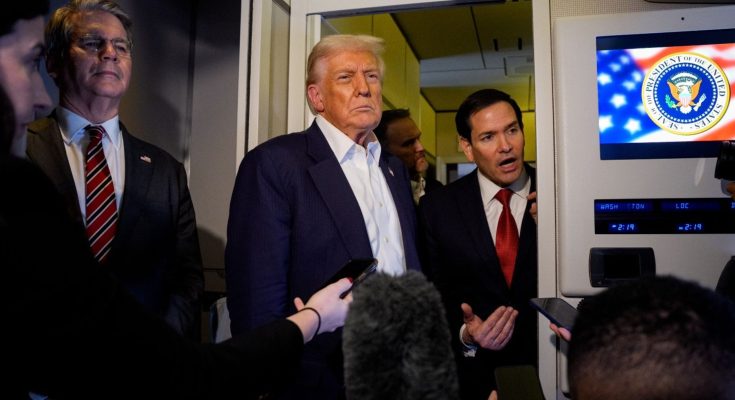
Secretary of State Marco Rubio has described an unusually tense stretch aboard Air Force One, when senior officials spent about 90 minutes trying to decide whether an unidentified passenger on a conference-room couch was merely sleeping — or had died.
Rubio told the story on The Katie Miller Podcast, appearing with his wife, Jeanette. The episode, he said, happened on a return flight to the United States from China. The passenger was lying on one of the couches in the aircraft’s conference room and appeared so still that officials could not tell if the person was alive.
“For a significant period of this flight, it was debatable whether this person had passed away or not,” Rubio said. He could not see the chest rising and falling in a reliable way. “I couldn’t establish a consistent breathing pattern in the individual. But I also didn’t want to wake them up on the one hand, or discover a dead body on the other.”
That hesitation produced an awkward standoff. Waking a deep sleeper would have been embarrassing. Confirming a death on the presidential aircraft would have raised a different problem: Rubio said he did not know the protocol for a body on Air Force One. Officials debated whether to intervene, whether to call a doctor, and whether to leave the person alone. The discussion, he said, lasted roughly an hour and a half.
What made the scene more unsettling was the environment. There was noise in the cabin. The lights were on. People were moving and talking. The passenger still did not respond. “This person was not responding to any of the stimulus,” Rubio said. At times he thought he saw a faint breath, then doubted it. “You could see every now and then that there was like, maybe a breath, but I don’t know how you sustain life at that pace of respiration.”
Jeanette asked whether he kept watching. Rubio said he did, in part so he could later account for when he first noticed the situation if the worst proved true. In hindsight he told the story with humor. At the time, he framed it as a genuine dilemma aboard the most closely watched aircraft in the U.S. government.
The scare ended without a medical emergency. Rubio said the person was fine and had simply been asleep. He declined to name the passenger, and no official identification has been released. Online guesses — ranging from other officials to well-known political figures — remain speculation without evidence.
The anecdote has circulated widely because it is both comic and slightly grim: a group of senior officials circling a motionless figure, unsure whether they were looking at exhaustion or a crisis. Air Force One is built for command, communications, and continuity of government. It is not designed for the ordinary workplace problem of whether to poke a colleague who looks too still. Rubio’s account suggested even that plane is not immune to human uncertainty.
The story also underlines how little public information exists about routine life on presidential flights. Conference rooms, couches, doctors on board, and informal debates among Cabinet officials are rarely described in real time. Rubio offered one of the few first-person glimpses — and then closed the most interesting detail. The mystery sleeper, he said, woke up. Who it was, he still will not say.
For about 90 minutes, the question on Air Force One was almost primitive: Was the person sleeping, or was something seriously wrong? According to Rubio, the answer was sleep. The identity of the passenger remains the one part of the story that never woke up.