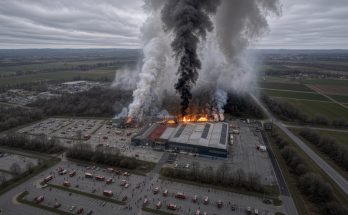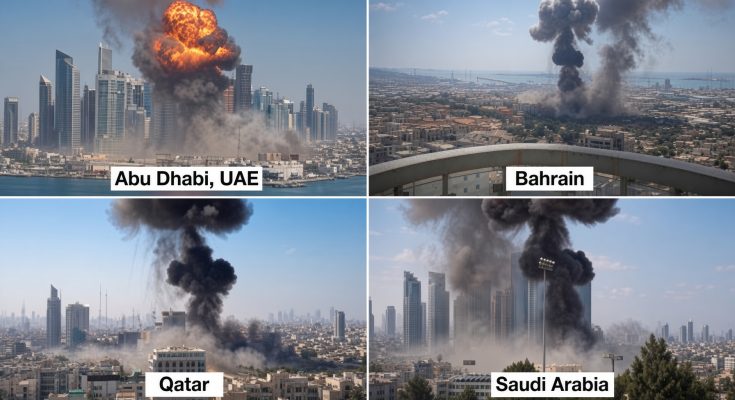
The Persian Gulf is back on a war footing after Iran launched missiles and drones at sites hosting U.S. forces, forcing Gulf partners to fire interceptors and send emergency alerts through cities already living under the threat of the next salvo. What began as a U.S.-Iran fight has repeatedly spilled onto the soil of Bahrain, Qatar, Kuwait, and the United Arab Emirates — countries that host American troops and now absorb Iranian fire aimed at those bases. Reuters and other outlets have documented multiple rounds of such attacks this year.
U.S. installations in those four states sit well inside the range of Iran’s short-range ballistic missiles and one-way attack drones. That geography is the strategy. Tehran treats the bases as legitimate targets whenever it answers American or Israeli strikes. Washington treats the same bases as the backbone of its regional presence. Gulf governments are caught in between: they wanted a U.S. security umbrella and instead became the battlefield.
In the UAE, air defenses have intercepted incoming missiles and drones; Iranian media has claimed hits on facilities tied to U.S. operations. Al Dhafra Air Base, a hub for American aircraft, has been among the sites under pressure. Officials and analysts caution that any single barrage’s damage should wait on on-the-ground assessments and independent imagery. Earlier waves this year did leave confirmed scars on infrastructure across the Gulf.
Bahrain hosts Naval Support Activity Bahrain, headquarters of the U.S. Fifth Fleet. Iran has claimed strikes on U.S.-linked sites there, including around Sheikh Isa Air Base. Bahraini authorities have reported intercepts and, in prior barrages, civilian harm from falling debris. Qatar’s Al Udeid Air Base — among the largest U.S. installations in the Middle East — has been targeted repeatedly; satellite imagery after earlier attacks showed damage to parts of the American footprint. Kuwait’s Ali Al Salem Air Base and other sites supporting U.S. forces have also come under fire, with Kuwaiti batteries engaging incoming weapons. Iran’s Revolutionary Guard has publicly named Patriot batteries, radars, fuel stores, and command nodes as aims. U.S. officials have often said incoming fire was intercepted or caused no American fatalities in a given wave, even when facilities were hit.
The war has already shown the limits of missile defense. Cheap drones and massed short-range missiles have leaked through, damaged radars and fuel farms, and forced some U.S. personnel off bases into hotels and offices. A June memorandum of understanding briefly paused the exchange; after it collapsed in July, salvos resumed. An IRGC statement in early September again claimed combined missile-and-drone operations against American positions in Jordan, Bahrain, and Iraq.
Over that hangs the Strait of Hormuz. Fighting around the Gulf has already throttled commercial shipping through a waterway that carries a large share of seaborne oil. Each new launch raises the chance of another shock to crude prices and global inflation.
For U.S. forces and host nations, the work of the hour is intercept, assess, and harden. For everyone else, the question is whether the next missile is the one that turns a grinding base war into a wider regional break. The Gulf is already under that pressure. One more major step up would be hard to walk back.