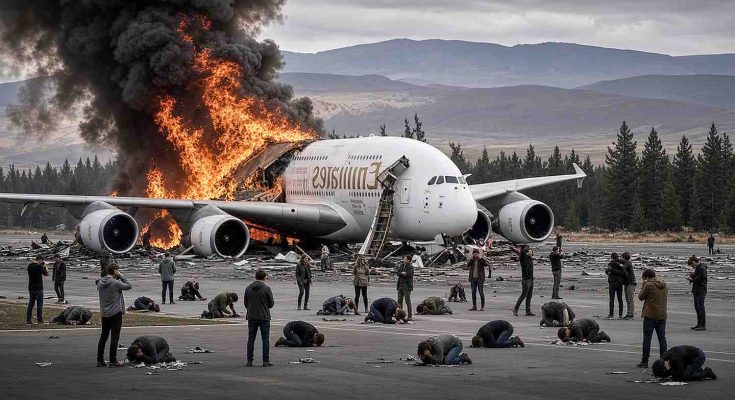
DUBAI — What began as a routine Emirates flight from Thiruvananthapuram, India, to Dubai ended in fire on the runway at Dubai International Airport after a hard landing. All 282 passengers and 18 crew members escaped. One firefighter was killed fighting the blaze.
Emirates Flight EK521 approached the airport on a clear afternoon. Shortly before landing, the crew issued a precautionary warning about a possible landing-gear problem. Many passengers treated it as a standard announcement. At 12:45 p.m. local time, the jet touched down, skidded and erupted in flames. Smoke filled the cabin within moments.
**Evacuation under fire**
Emergency slides were deployed as the cabin filled with smoke. Passengers left bags behind and crowded toward the exits. Flight attendants and ground crews directed the evacuation. Within minutes, all 300 people aboard were off the aircraft. The jet was soon engulfed on the runway.
Ten passengers were taken to hospitals. None of the injuries were reported as life-threatening. Survivors later described heat, alarms and crew members shouting instructions as they slid to the tarmac and watched the aircraft burn.
**A firefighter killed**
The only fatality was a firefighter who died during the rescue. Emirates expressed relief that everyone on board survived and offered condolences to the firefighter’s family. His death underscored the risk first responders accept when they move toward a burning aircraft.
Dubai International temporarily halted operations. Flights were delayed and canceled while emergency crews worked the scene. Photos and video of the burning jet spread worldwide within hours.
**Early theories, no final finding in first hours**
Early accounts pointed to wind shear — a sudden shift in wind speed or direction — as a possible factor in the failed landing. Passengers also recalled the landing-gear warning. Officials did not immediately confirm either cause. Investigators said black-box data, maintenance records and weather information would have to be examined before any conclusion.
Aviation specialists cautioned that such inquiries take time and that a single factor rarely explains a runway fire after a hard landing.
**Crew and rescuers credited**
Emirates said the outcome depended on crew training and a fast ground response. Flight attendants kept the evacuation moving despite smoke and panic. Firefighters worked in intense heat and toxic fumes. Together they prevented a far larger loss of life.
Survivors described clutching children on the slides and the shock of standing clear while the aircraft was destroyed. Those accounts, officials said, would feed later reviews of emergency procedures.
**What the industry takes from it**
Commercial flying remains statistically among the safest forms of travel, but runway accidents still test cabin design, crew drills and airport firefighting. The EK521 fire became a case study in how quickly a landing can turn into an evacuation — and how much those minutes depend on training.
For Emirates and Dubai authorities, the immediate task was accounting for the injured, honoring the firefighter who died and supporting the investigation. For passengers, the story ended on the tarmac: a burning wide-body jet behind them, and every person who had boarded in India still alive.