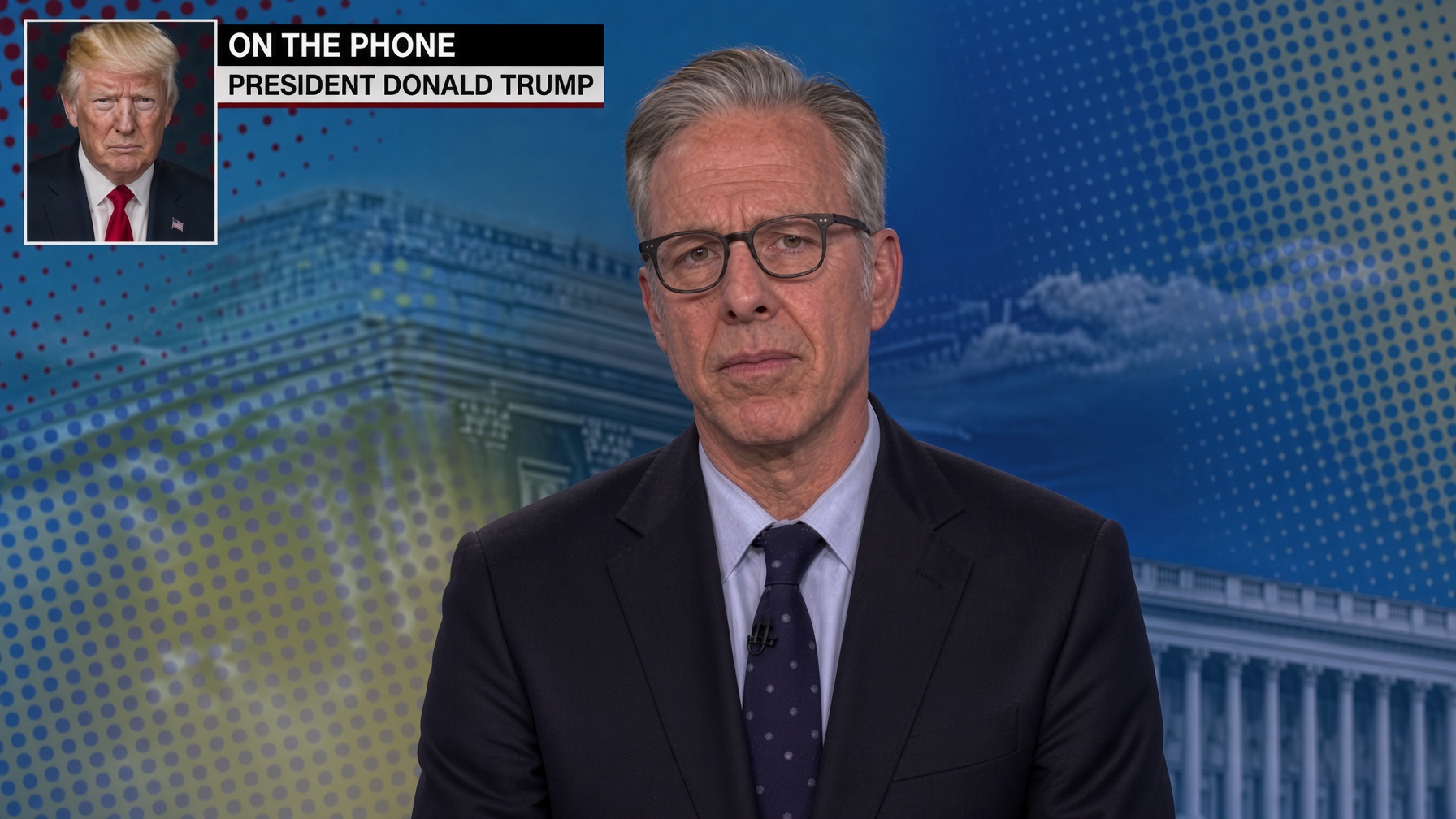
WASHINGTON — President Donald Trump used a brief July 12 appearance on CNN to reopen his long-running feud with the network, telling anchor Jake Tapper that he was trying to move CNN onto what he called a “normal path.”
The exchange came at the end of a short telephone interview on *State of the Union*. Trump had called the program to discuss the sudden death of Sen. Lindsey Graham, the South Carolina Republican and longtime political ally.
Tapper first focused on Graham and his political legacy. When the anchor tried to shift to other subjects, including the conflict involving Iran, Trump declined, saying he wanted to speak about Graham out of respect for the late senator.
As the conversation wrapped up, Tapper invited Trump back for a longer interview. Trump agreed. Then, unprompted, he turned to CNN.
“We’re trying to have CNN go on a normal path,” Trump said. “And we will do that.”
Tapper replied, “Well, I’m on a normal path right here, sir, and I appreciate your time.”
Trump answered, “Good. You are.”
The remarks were recorded in CNN’s transcript of the interview.
**A short line with a long history**
The comment drew immediate attention because of Trump’s years of criticism of CNN’s coverage of his campaigns, presidency and policies. That history made his decision to appear on the network’s flagship Sunday show notable on its own.
The July interview did not explain what Trump meant by a “normal path.” He did not name editorial policies he wanted changed or describe any mechanism through which the White House would direct CNN’s journalism. The statement therefore does not establish that the administration controls CNN’s editorial decisions. It does show Trump’s view that the network should change course.
**CNN in the middle of a ownership fight**
The remarks landed as CNN’s parent company, Warner Bros. Discovery, sat at the center of a proposed $110 billion acquisition by Paramount Skydance. In June, the Justice Department’s Antitrust Division said it had completed its review and found the deal unlikely to harm competition or consumers.
If completed, the transaction would place CNN and CBS News under the same corporate roof, combining two major television news organizations with large entertainment and streaming businesses. That prospect has fueled debate over media consolidation and the future editorial direction of both newsrooms.
**New promises of independence — and new doubts**
The ownership fight has also produced proposals meant to protect journalism. As part of a September settlement involving Paramount, a coalition of 12 states and the Writers Guild of America, Paramount Skydance CEO David Ellison agreed to create a five-member editorial-independence board for CNN and CBS News. The board would set principles for journalism and editorial standards at the combined operations.
Critics have questioned whether that board would have real power. Reuters reported that some media experts and journalists argued its members would remain tied to the corporate ownership structure. Those concerns are part of a wider debate over how to protect editorial independence when large private companies control major news organizations.
The settlement removed a significant legal obstacle, but the deal still faces additional legal and regulatory steps.
**A complicated relationship, unchanged**
The July exchange therefore arrived at a sensitive moment for CNN. A president who has repeatedly attacked the network appeared on its Sunday program and agreed to return. At the same time, CNN was preparing for a possible change in ownership that could reshape the company.
The transcript itself offers no evidence that Trump was announcing a government-directed overhaul of CNN’s newsroom. “Normal path” was left undefined.
For CNN, the episode underscored the uneasy relationship between a president who has long criticized the network and a news organization that continues to interview him. For Trump, the brief remark was another public signal of dissatisfaction — and of his desire to see the network change direction.
Whether that direction changes under new corporate ownership remains an open question. For now, the July exchange stands as a revealing moment in the continuing clash among Trump, CNN and a rapidly consolidating U.S. media industry.