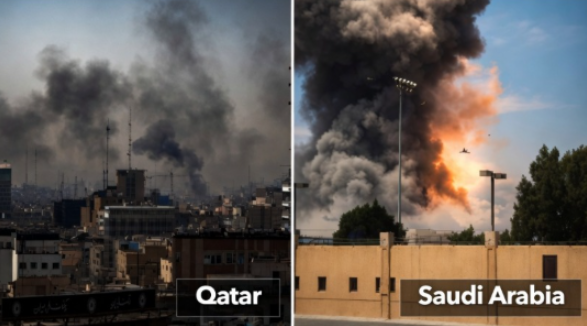
The Middle East has been thrust into one of its most dangerous moments in recent memory after Iran launched a sweeping wave of missile and drone attacks targeting U.S.-linked military installations across the Persian Gulf, dramatically raising fears that the region could be on the brink of a much wider conflict.
According to Iranian state media, the coordinated strikes were carried out as part of “Operation True Promise,” a retaliatory campaign launched in response to earlier U.S. and Israeli military actions against Iranian targets. While Tehran portrayed the attacks as a major strategic success, U.S. and Gulf officials said air defense systems intercepted many of the incoming threats, and independent assessments of the overall damage are still emerging.
One of the primary targets was Al Dhafra Air Base in the United Arab Emirates, a key hub for U.S. military operations in the region. Witnesses reported hearing multiple explosions as ballistic missiles streaked through the sky. Advanced THAAD and Patriot missile defense systems engaged the incoming projectiles, but officials acknowledged that some strikes caused damage to military infrastructure.
Satellite imagery released after the attack reportedly showed damaged hangars, support facilities, and other structures at the base. UAE authorities temporarily closed national airspace, increased security across the country, and urged residents to avoid military areas while emergency crews assessed the situation.
Bahrain also found itself at the center of the escalating crisis. Explosions were reported near the Al Jufair district in Manama, home to the headquarters of the U.S. Navy’s Fifth Fleet. Smoke could be seen rising over portions of the area as air defense systems responded to incoming threats.
Iranian media claimed the attacks successfully struck naval facilities, while Bahraini officials confirmed emergency procedures had been activated and advised residents to shelter in place as security forces secured the surrounding area.
In neighboring Qatar, explosions echoed across Doha as Patriot missile batteries intercepted projectiles reportedly aimed at installations supporting U.S. Central Command operations. Authorities declared a high-alert status, temporarily suspended air traffic, activated emergency response plans, and instructed residents to remain indoors while military officials monitored the situation.
Kuwait also reported missile activity, with loud explosions heard near military facilities linked to U.S. operations, including Ali Al Salem Air Base and Camp Buehring. Preliminary reports suggested damage to portions of runways, storage facilities, and support infrastructure, although officials continue to evaluate the full extent of the impact.
The latest strikes come after months of growing confrontation. Since late February, Iran has reportedly launched repeated waves of missiles and drones targeting U.S. and allied positions throughout the Gulf. Although sophisticated air defense systems have intercepted many of the attacks, military analysts say the cumulative cost of the conflict has reached billions of dollars in damaged equipment, infrastructure, and operational disruptions.
Beyond the battlefield, the crisis is sending shockwaves throughout the global economy. Temporary airspace closures have disrupted commercial aviation across the region, while renewed concerns over the security of the Strait of Hormuz have fueled volatility in global energy markets. Governments throughout the Gulf have strengthened security around critical infrastructure and placed military forces on heightened alert.
Despite the dramatic escalation, competing claims continue to emerge from both sides. Iranian officials have emphasized what they describe as successful strikes against strategic military targets, while U.S. and Gulf governments maintain that layered missile defenses prevented far greater damage and preserved operational readiness. Independent verification through satellite imagery and official investigations remains ongoing.
With tensions at their highest point in years, military experts warn that even a single miscalculation could trigger a broader regional conflict involving multiple nations. As governments monitor the rapidly evolving situation, the world is watching closely to see whether diplomacy can contain the crisis—or whether the latest exchange marks the beginning of an even more dangerous chapter in the Middle East.