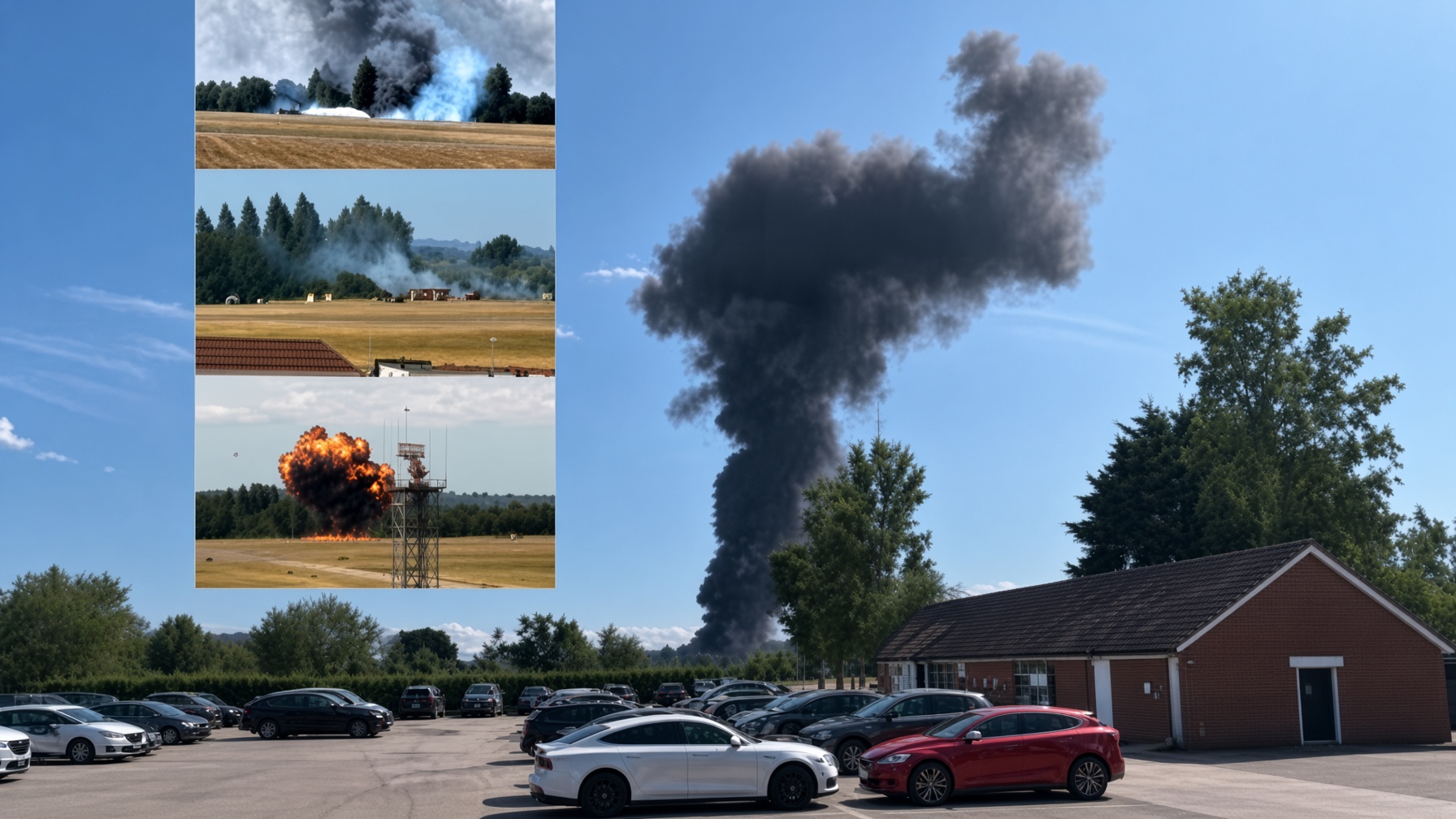
DUBAI — All 300 passengers and crew aboard an Emirates Boeing 777-300 escaped alive Wednesday after the wide-body aircraft crash-landed and erupted into flames on the runway at Dubai International Airport. The miraculous evacuation, however, was marred by tragedy when a responding Emirati firefighter lost his life battling the fierce inferno.
Flight EK521, originating from Thiruvananthapuram in southern India, touched down under distressed conditions at approximately 12:45 p.m. local time. Emirates Chairman and Chief Executive Sheikh Ahmed bin Saeed Al Maktoum confirmed that all 282 passengers and 18 crew members evacuated rapidly before flames engulfed and gutted the aircraft fuselage. Ten individuals were transported to regional hospitals, while dozens of others were treated on-site for minor injuries, smoke inhalation, and exhaustion.
The fallen firefighter was identified as 27-year-old Jasim Issa Mohammed Hassan, a native of Ras Al Khaimah. Civil defense officials stated that Hassan died while heroically containing the rapidly spreading flames around the burning wreckage. Several other rescue personnel sustained injuries during the volatile suppression effort.
A Scramble Down Escape Slides
Eyewitness video circulating on social media showed thick black smoke billowing into the midday desert sky as flames tore through the top of the aircraft cabin. Passengers described scenes of confusion and urgency following an unstable approach. Passenger Iype Vallikadan recounted that the flight crew had alerted travelers to an issue concerning the landing gear prior to touchdown, instructing everyone to prepare for an emergency landing.
Preliminary findings indicate the flight crew attempted an aborted landing and initiated a go-around maneuver after floating past their intended touchdown point. The twin-engine jet then struck the tarmac belly-first, collapsed onto its starboard engine, and slid hundreds of meters on the runway before grinding to a halt. As cabin crews deployed inflatable slides, a massive explosion erupted from the central fuel tank, violently shearing off the right wing and consuming the airframe. The jet, registered as A6-EMW, was completely written off.
The manifest reflected an international cross-section of global travelers: 226 passengers held Indian nationality, 24 were British, 11 were Emirati, six were American, six were Saudi Arabian, five were Turkish, and four were Irish, alongside citizens from Australia, Brazil, Germany, Malaysia, and Thailand. Emirates noted that the flight deck was commanded by seasoned aviators—an Emirati captain and an Australian first officer—each possessing over 7,000 recorded flight hours.
Global Hub Disrupted Amid Investigation
The accident brought operations at Dubai International Airport, the world’s busiest hub for international passenger traffic, to a complete standstill. Ground stops and diversions snarled regional flight networks for nearly six hours before outbound and inbound flights resumed under reduced capacity just before 7:00 p.m. local time.
The United Arab Emirates General Civil Aviation Authority (GCAA) mobilized an official crash investigation team to secure the flight data and cockpit voice recorders. The U.S. National Transportation Safety Board (NTSB) and airframe manufacturer Boeing confirmed their readiness to dispatch technical advisors to examine mechanical systems, engine telemetry, and crew responses.
Sheikh Ahmed suggested that sudden wind shear—an abrupt shift in wind velocity and direction near ground level—may have destabilized the aircraft on final descent, though investigators cautioned that a definitive conclusion will require a meticulous review of meteorological radar, air traffic communications, and flight control inputs.
The catastrophic hull loss marks the first such operational loss for Emirates since the state-owned carrier was founded in 1985.