The following is a hypothetical military scenario, not a report of an actual attack. It is offered as an analysis of how a modern U.S. carrier strike group might respond to a saturation missile strike in the Strait of Hormuz.
In the narrow waters of the strait — a chokepoint for a large share of the world’s seaborne oil — planners have long studied a worst-case Iranian ambush: dozens of anti-ship missiles fired in a coordinated salvo at a U.S. aircraft carrier and its escorts. In this fictional case, 32 missiles are launched with roughly three minutes and 40 seconds of flight time remaining. About 4,700 sailors would be at risk if the defense failed.
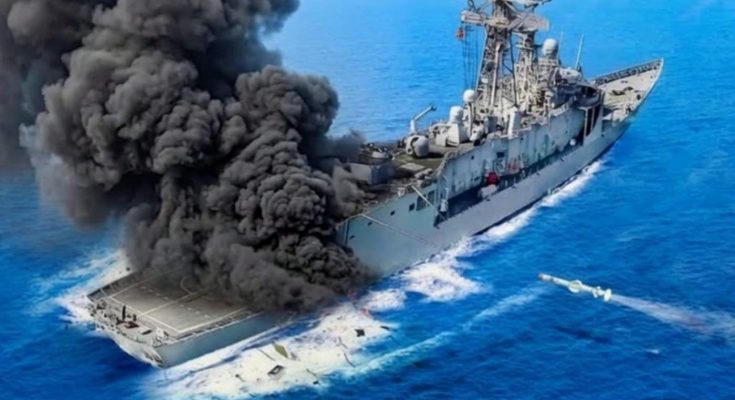
The imagined attack is a classic saturation strike. Coastal batteries, kept off radar until launch, fire missiles with seekers designed to confuse defenses and arrive nearly together. The goal is not one lucky hit but to overwhelm interceptors, radars, and decision-makers at the same moment.
A U.S. carrier does not sail alone. Aegis destroyers and cruisers form a layered shield: long-range Standard missiles, medium-range interceptors, and last-ditch close-in weapons. Detection would begin seconds after launch. Interceptors would leave the rails almost immediately. In published Navy doctrine, the first shots of the engagement are defensive, not offensive.
Electronic warfare would run in parallel. An attacker might try to jam radars and data links. The strike group would answer with its own jamming, decoys, and emission control so ships can still share tracks. That contest in the electromagnetic spectrum often decides whether the physical interceptors have a clean picture.
If incoming missiles are largely stopped, the scenario turns to retaliation. Tomahawk cruise missiles from surface ships and submarines could be tasked against launch sites, command posts, and supporting radars. The analytic point of the exercise is that the first salvo rarely ends the fight. The second and third moves — who still has sensors, magazines, and communications — usually do.
In the 32-minute timeline used here, the modeled result is a failed ambush and heavy losses for the attacker’s coastal missile force. That outcome is not a prediction. It assumes working sensors, trained crews, enough interceptors, and political authorization to shoot back. Real war would add weather, mistakes, civilian shipping, and the risk of wider escalation.
The Strait of Hormuz remains one of the most sensitive waterways on Earth. Any live clash there would threaten energy markets and draw in regional and global powers within hours. That is why militaries war-game these problems in peacetime: to test whether layered air defense, electronic warfare, and rapid counterstrike can keep a carrier group intact when the clock is measured in minutes.
This account is fiction built from public concepts of naval defense. It is not intelligence, not an official record, and not a forecast of what Iran or the United States would do. It is a reminder that in modern naval warfare the opening shot is only the start of the problem.