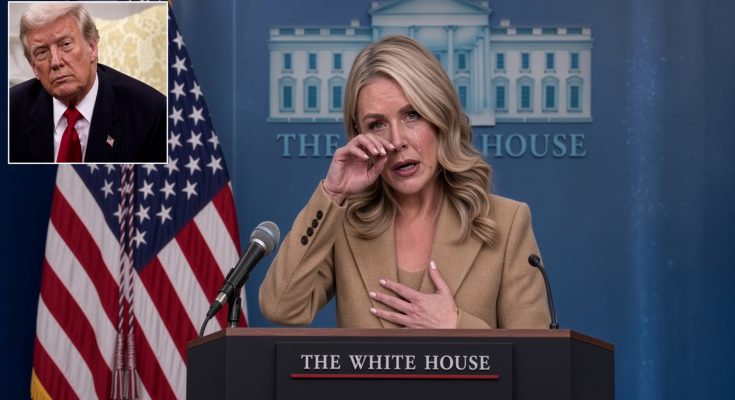
WASHINGTON — White House Press Secretary Karoline Leavitt told Axios in April 2025 that the Trump administration’s overhaul of presidential press access was meant to widen participation, not shrink it. Speaking with Axios co-founder Mike Allen, she rejected the label “restrictions.”
“I don’t view them as restrictions,” Leavitt said. “We view them as opening access to more outlets, more voices, more news, journalists and outlets.” She added that the approach was “not about ideology” and asked why any single outlet should hold a daily seat in a 13-person pool. Those remarks framed a shift that later grew into a running legal fight over who controls limited-space coverage of the president.
The presidential press pool exists because not every reporter can fit into the Oval Office, Air Force One, or other cramped venues. Pool members share notes, photos, and video with the rest of the press corps. For decades, the White House Correspondents’ Association helped coordinate the rotation. The administration moved that power into the press office, arguing that a small group of legacy organizations should not lock in the same slots every day.
Leavitt also opened briefing-room seats to “new media voices” — independent journalists, podcasters, digital outlets, and social-media creators. She tied the policy to Trump’s 2024 campaign, which relied heavily on nontraditional platforms. Supporters say the audience has already moved online and that access should follow. Critics say when the government picks the rotation, it can favor friendlier questions and sideline adversarial coverage.
The Associated Press became an early test. After AP declined to adopt the administration’s preferred name “Gulf of America” for the body of water long called the Gulf of Mexico, the White House limited AP access to some events. AP sued, arguing the penalty targeted editorial speech. A federal judge ordered access restored, holding that if the government opens limited spaces to some journalists, it cannot close them to others because of viewpoint. An appeals court later narrowed that relief, leaving parts of the dispute alive.
The conflict sharpened in September 2026. After Trump accused CNN, MS NOW, and Politico of “fake news,” those outlets were barred from White House grounds; reporters’ badges were deactivated and they were turned away. The three organizations sued in federal court in Washington, seeking a temporary restraining order and calling the ban a First Amendment assault. They say the government does not get to decide what the press publishes. Trump has described the move as a response to dishonest coverage, not an attack on a free press. A hearing was set before U.S. District Judge Timothy Kelly.
The ban also disrupted the traditional television pool. Major networks issued a joint statement, and the TV pool declined to cover Trump’s United Nations General Assembly trip. That left a practical gap in shared footage of a major presidential event.
The core dispute is now institutional as much as personal. Physical space around a president is limited. The questions are who assigns the scarce seats — the White House, journalists through their own associations, or some mix — and whether exclusion based on coverage crosses a constitutional line. Leavitt’s 2025 pitch was expansion of voices. The 2026 lawsuits show that who gets through the gate remains unsettled.