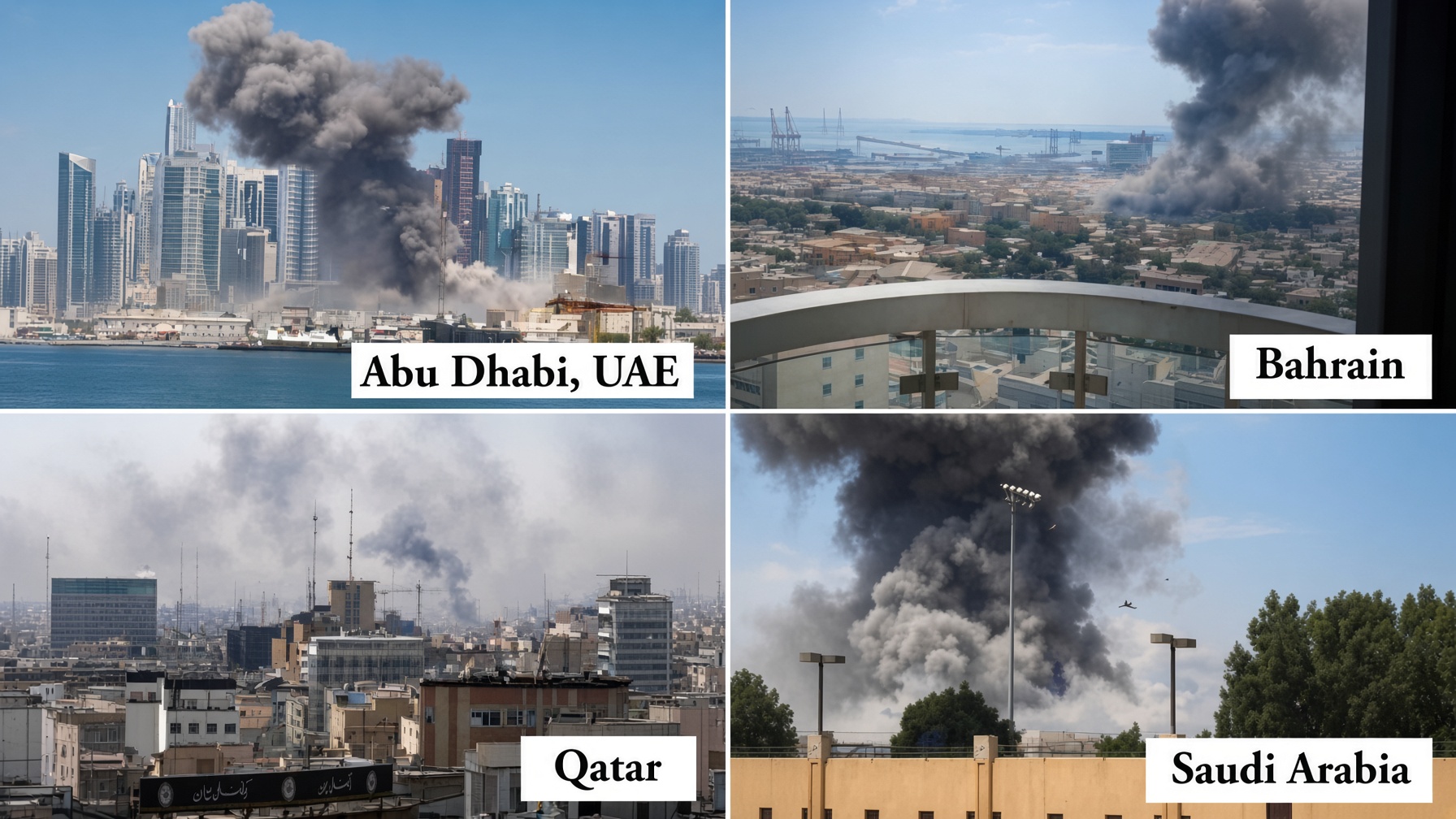
DUBAI / MANAMA — Air defense sirens echoed across Gulf capitals this week as Iran unleashed coordinated waves of ballistic missiles and loitering munitions against installations hosting U.S. forces, puncturing hopes of containment and pushing the strategic waterway toward a wider regional conflagration.
The barrages mark a sharp operational shift from localized shadow skirmishes to direct, overt theater strikes. With Washington stationing tens of thousands of personnel across Bahrain, Qatar, Kuwait, and the United Arab Emirates, allied nations found their sovereign airspace converted into an active intercept corridor overnight.
Multi-Front Pressures on Allied Hubs
In the United Arab Emirates, integrated missile shields engaged incoming targets over critical corridors. Attention focused sharply on Al Dhafra Air Base, a premier hub for American combat aviation, intelligence, and aerial refueling. While official damage assessments remain closely guarded and subject to satellite verification, the sheer volume of incoming fire underscores that high-tier Gulf bases no longer operate under an impenetrable umbrella.
Further north, the security perimeter tightened dramatically around Naval Support Activity Bahrain in Manama—the command nerve center for the U.S. Navy’s Fifth Fleet and the broader Combined Maritime Forces. Along with air installations such as Sheikh Isa Air Base, Bahrain sits squarely in the operational crosshairs. Western defense officials noted that while multi-tiered interceptors thwarted the bulk of the salvos, the sustained saturation tactics are designed to strain interceptor stockpiles and test allied reaction times.
A similar operational tempo gripped Qatar and Kuwait:
-
Al Udeid Air Base (Qatar): As the forward headquarters for U.S. Central Command (CENTCOM), the base faced immediate defensive postures amid repeated drone threats, building on previous episodes where perimeter infrastructure sustained collateral impact.
-
Kuwaiti Installations: Air defense batteries in Kuwait intercepted inbound threats tracking toward logistical and staging facilities, placing host authorities in the delicate position of repelling strikes stemming from a confrontation beyond their borders.
The Chokepoint Dilemma
Beyond the military installations, the geographic core of the confrontation remains the Strait of Hormuz—the vital conduit through which approximately one-fifth of global petroleum liquid consumption passes.
Commercial maritime traffic across the corridor has ground into defensive rerouting. Marine insurers have dramatically spiked war-risk premiums, while commercial carriers weigh whether passage through the narrow shipping lanes remains tenable under persistent drone and fast-attack craft risks. Analysts warn that even an accidental impact on commercial tankers or offshore energy terminals could trigger an immediate, destabilizing supply shock across global energy markets already sensitive to regional volatility.
A Fragile Deterrence Envelope
For Washington and its regional partners, the operational priority remains threat interdiction, rapid infrastructure triage, and real-time intelligence sharing. Yet the strategic dilemma deepens: defensive successes buy operational time, but they do not eliminate the escalatory momentum.
With Iran demonstrating both the political will and logistical capacity to strike dispersed American assets simultaneously, the deterrence equilibrium in the Gulf has narrowed to a razor-thin margin. One missed interception—or one fatal strike on allied personnel—risks converting the current cycle of tit-for-tat salvos into an uncontrolled, theater-wide war.