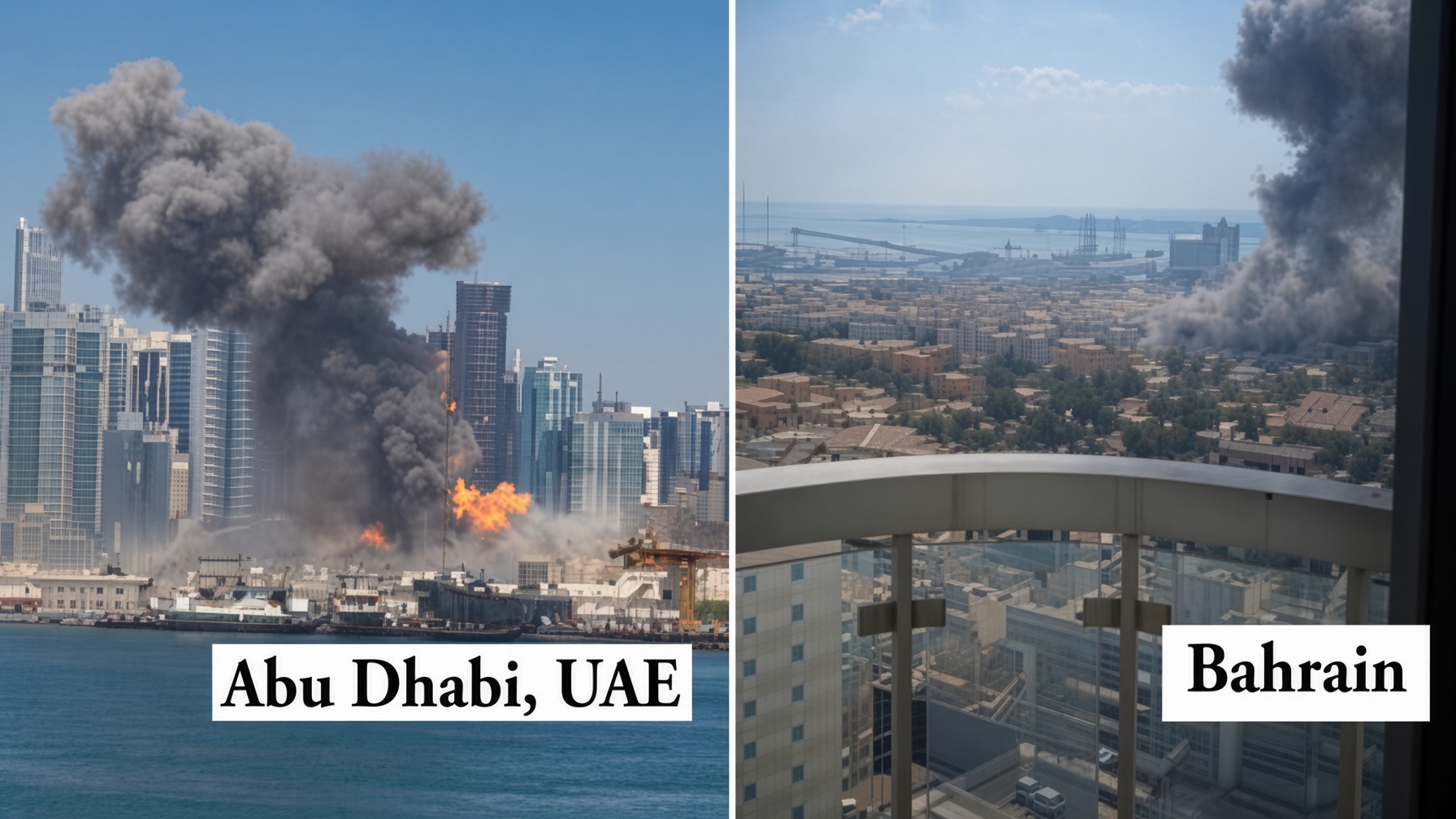
DUBAI, United Arab Emirates — The Persian Gulf has been thrust into high-intensity alert following coordinated waves of Iranian ballistic missiles and one-way attack drones aimed at military installations hosting American personnel across the region. The strikes forced regional allies to scramble integrated air defenses and sounded sirens across major civilian centers.
The offensive underscores how rapidly the confrontation has widened beyond localized flashpoints. With the United States maintaining forward-deployed garrisons, naval commands, and air wings across Bahrain, Qatar, Kuwait, and the United Arab Emirates, Gulf partners find themselves directly on the frontline of Tehran’s asymmetric campaign.
Gulf Allies Scramble Integrated Air Defenses
In the United Arab Emirates, interception detonations lit up the skies above metropolitan centers as multi-layered air defense systems engaged inbound threats. Al Dhafra Air Base—a vital operational hub housing American aerial reconnaissance, fighter squadrons, and coalition command units—has repeatedly featured among high-priority targets claimed by Iranian forces.
Simultaneously, air defense batteries across Bahrain, Kuwait, and Qatar were placed on emergency response status to track saturation salvos traversing Gulf airspace.
| Strategic Base | Host Country | Operational Role / U.S. Presence | Threat Level |
| Al Dhafra Air Base | United Arab Emirates | Aerial refueling, ISR, multi-role fighter wings | Critical (Repeated missile/drone vectors) |
| NSA Bahrain / Sheikh Isa | Bahrain | U.S. Naval Forces Central Command & Fifth Fleet HQ | Critical (Maritime command & logistics hub) |
| Al Udeid Air Base | Qatar | Forward CENTCOM HQ & Combined Air Operations Center | Severe (Targeted infrastructure; hardened silos) |
| Camp Arifjan / Ali Al Salem | Kuwait | Theater logistics hub & forward air assets | Elevated (Air defenses active on incoming paths) |
Critical Chokepoint: The Strait of Hormuz at Risk
Beyond the immediate danger to military personnel, the expanded theater of operations threatens the Strait of Hormuz, the narrow waterway through which roughly one-fifth of global crude petroleum passes daily.
Naval skirmishes, loitering munitions, and coastal anti-ship missile locks have severely disrupted commercial shipping lanes. International maritime insurers have responded by sharply increasing war-risk premiums, forcing global energy carriers to weigh perilous detours. Analysts warn that sustained military exchanges in the strait could deliver an immediate, destabilizing shock to global energy supply lines and fragile international markets.
The Peril of Regional Spillover
The current confrontation highlights a volatile strategic dynamic: while Washington and its regional partners prioritize kinetic interception, sensor networking, and damage mitigation, the sheer volume of attacks heightens the risk of defensive saturation.
Military strategists caution that each successive missile barrage and retaliatory sortie narrows remaining diplomatic off-ramps. With defense networks across the Arabian Peninsula operating on sustained maximum alert, an errant warhead or mass-casualty strike at any forward garrison could push the entire Gulf corridor into an uncontrollable, multi-front war.