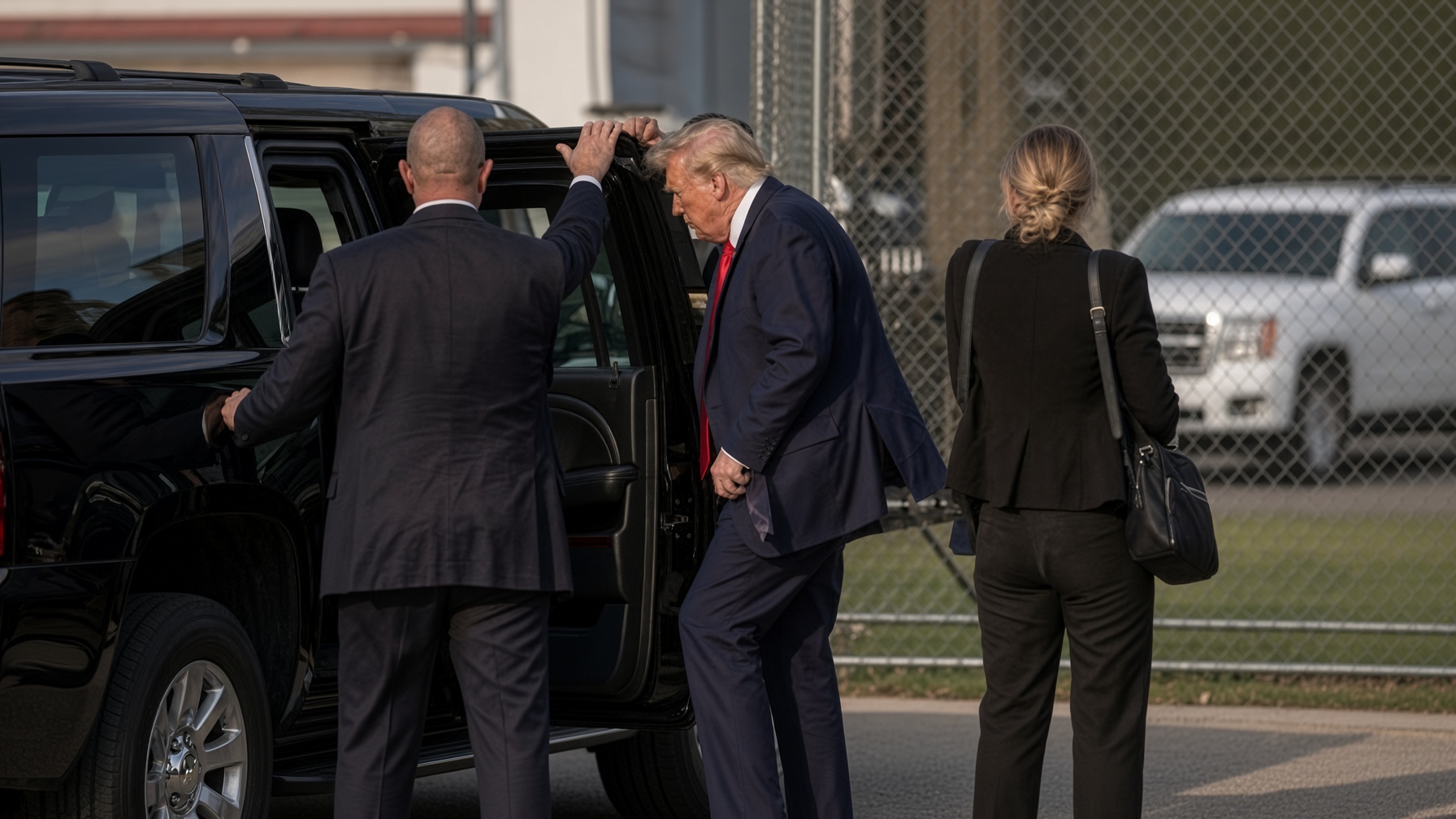
WASHINGTON — A wave of unverified claims alleging that President Donald Trump suffered a serious physical stumble while ascending the stairs of Air Force One has triggered renewed digital speculation regarding his health, spreading rapidly across social platforms just as the administration enters a critical round of high-stakes international diplomacy.
The posts, which proliferated across X, TikTok, and digital aggregators, claimed the president lost his footing prior to a scheduled departure for Florida. Commentators quickly framed the purported incident as evidence of physical decline under the weight of an intensive autumn travel schedule and sensitive geopolitical negotiations surrounding the war in Eastern Europe.
Yet an exhaustive review of visual records, tarmac pool logs, and flight-line dispatches reveals no primary-source evidence corroborating that any such fall or balance failure took place. No authenticated video footage, verified still photography, travel pool alert, or medical bulletin from the White House has substantiated the claims.
Diplomatic Stakes Magnify Public Scrutiny
The viral rumors surfaced at an exceptionally sensitive juncture on the diplomatic calendar, as preparations advanced for a bilateral engagement between Trump and Ukrainian President Volodymyr Zelenskyy on the sidelines of the United Nations General Assembly in New York.
Zelenskyy announced that the two leaders had held a substantive telephone consultation, agreeing to convene in person during the annual diplomatic gathering in Manhattan. The Ukrainian head of state characterized the exchange as productive, noting that strategic dialogue had gained momentum amid shifting battlefield dynamics and escalating international debates over long-term Western military and financial commitments.
According to diplomatic reporting, the anticipated bilateral agenda centers heavily on brokering an urgent energy truce between Kyiv and Moscow. The discussions arrive against a backdrop of renewed Russian missile barrages battering Ukraine’s power generation facilities and reciprocal Ukrainian drone strikes penetrating deep into Russian petrochemical and refining infrastructure.
With Trump’s U.N. docket packed with high-level bilaterals alongside European allies, Middle Eastern delegations, and Asian trade partners, the grueling pace of executive diplomacy has naturally concentrated attention on the physical stamina demanded of the American commander-in-chief. In such an environment, unverified claims of physical vulnerability quickly acquire outsized geopolitical resonance.
Phantom Whistleblowers and Algorithmic Distortions
The online speculation accelerated significantly when fringe accounts began promoting an elaborate corollary narrative: that a White House or military medical officer had breached operational security—allegedly sacrificing a career and medical credentials—to leak an unannounced cardiovascular or neurological diagnosis.
Independent fact-checking networks and national security desks found zero factual foundation behind the narrative. No accredited physician has stepped forward, no documented medical disclosures have been transmitted to oversight committees or the press, and no clinical summaries have surfaced from Walter Reed National Military Medical Center or the White House Medical Unit.
Clinical practitioners and geriatric health specialists have routinely condemned the practice of extracting sweeping diagnostic conclusions from brief, low-resolution video clips or isolated physical movements.
Medical professionals point out that minor adjustments in stride on mobile airstairs can stem from a wide array of benign external factors: inclement weather, wind gusts on open flight lines, slick metal grating, variations in shoe tread, or the natural caution required when ascending steep aircraft stairs. Professional medical ethics codes explicitly dictate that complex clinical pathologies cannot be diagnosed remotely through algorithmic feeds, requiring instead comprehensive in-person evaluations, neuroimaging, laboratory panels, and longitudinal clinical baselines.
The episode mirrors a recurring pattern in modern political communications, where bad-faith actors deploy clipped archival footage, manipulated playback speeds, or generative artificial intelligence tools to manufacture synthetic medical crises. Recent forensic media reviews have repeatedly debunked viral claims asserting that Trump had collapsed or experienced acute medical distress, discovering that the underlying visual assets were either heavily edited out of context or generated through synthetic media tools designed to maximize algorithmic virality.
Disentangling Mechanical Anomalies From Medical Rumors
The current viral cycle also appears to have co-opted and conflated unrelated logistical mishaps that occurred during recent presidential travel movements.
On September 9, an operational anomaly took place at Joint Base Andrews in Maryland when an emergency evacuation slide accidentally deployed aboard the presidential aircraft, briefly delaying Trump’s departure for an official appearance in Texas. Official flight crews and maintenance technicians resolved the mechanical malfunction without incident, and federal authorities explicitly confirmed on the record that the delay was entirely mechanical in nature, involving ground equipment rather than any medical contingency affecting the president.
Nevertheless, in an attention economy dominated by rapid information churn, documented mechanical issues are frequently merged with fabricated rumors to lend a superficial veneer of credibility to unverified health claims.
The distinction between documented operational events and baseless digital gossip is particularly vital as executive movements face heightened public scrutiny. While presidential travel pools maintain continuous, unbroken visual observation of the commander-in-chief during all aircraft departures and arrivals, pool reporters embedded with the travel party filed no dispatches describing any fall, slip, or medical intervention during recent departures for Florida.
The Realities of Modern Information Ecosystems
The swift proliferation of the unverified boarding incident illustrates the persistent friction between the speed of digital media platforms and the exacting standards required for verified investigative reporting.
Algorithms calibrated to prioritize sensationalism and audience emotion frequently amplify unverified health claims long before institutional newsrooms or on-the-ground journalists can complete standard fact-checking procedures. In the absence of corroborated visual evidence or formal medical statements, the claims regarding a physical stumble and a concealed medical crisis remain internet fiction rather than verified news.
Confirmed public records demonstrate that President Trump continues to execute a demanding public schedule, with senior administration officials focusing their resources on complex bilateral talks with President Zelenskyy and broader international deliberations at the United Nations. Until primary documentation or official medical statements suggest otherwise, the reported Air Force One incident stands as a case study in how quickly viral speculation can outrun verifiable fact.