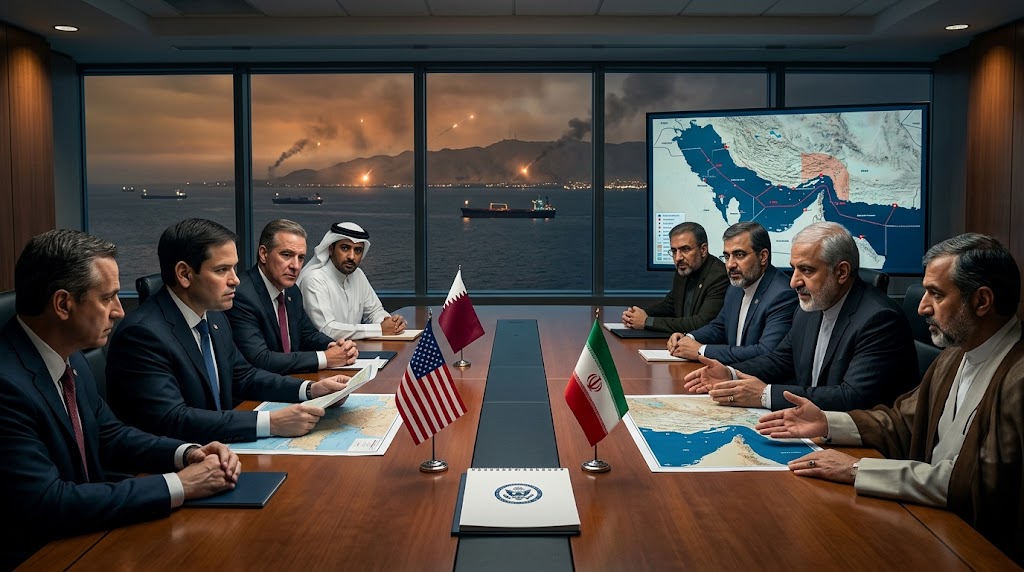
WASHINGTON — The Trump administration was pursuing negotiations with Iran while U.S. forces carried out additional strikes against Iranian military targets, creating a tense backdrop for diplomatic efforts aimed at ending the conflict and addressing the status of the strategically important Strait of Hormuz.
Secretary of State Marco Rubio said negotiations could take several more days as the two sides worked through the language of a potential preliminary agreement. His comments came as Iranian representatives traveled to Qatar for discussions involving the future of the ceasefire and broader arrangements with Washington.
Rubio said reopening the Strait of Hormuz remained a central U.S. demand.
“The straits have to be open, they’re going to be open,” Rubio told reporters, according to contemporaneous reporting. He said negotiators were discussing specific language for an initial document and that President Donald Trump wanted an agreement only if it met U.S. objectives.
The negotiations were complicated by continued military activity in the region.
U.S. Carries Out Additional Strikes
U.S. Central Command said American forces conducted what it described as self-defense strikes against targets in southern Iran. The strikes reportedly included missile-launch facilities and Iranian maritime assets that U.S. officials said were involved in threats to American forces and efforts to lay mines in regional waterways.
Iran subsequently characterized the attacks as a violation of the ceasefire, while Washington maintained that its forces were acting to protect American personnel and military assets.
The competing descriptions highlighted the fragile nature of the ceasefire. Although large-scale combat had declined compared with earlier stages of the conflict, military confrontations continued while negotiators attempted to preserve a diplomatic channel.
The Strait of Hormuz remained one of the most difficult issues. The waterway is a critical route for international energy shipments, and disruptions there have raised concerns about commercial shipping and global oil markets.
Negotiators Report Progress but No Final Agreement
Iranian Foreign Ministry spokesman Esmaeil Baqaei said Tehran had reached understandings on many of the issues under discussion but cautioned that significant disagreements remained.
Iranian officials also accused Washington of repeatedly changing its negotiating position, adding another complication to efforts to finalize an agreement.
The conflicting assessments underscored the gap between acknowledging progress and reaching a completed deal. Reuters reported that negotiators were attempting to resolve issues involving Iran’s nuclear program, sanctions relief, security arrangements and the Strait of Hormuz.
Earlier reports indicated that a potential framework could involve restrictions on Iran’s nuclear activities alongside arrangements intended to restore maritime traffic through the strait.
Nuclear Program and Sanctions Remain Central
Iran’s nuclear program remains one of the principal issues in negotiations.
U.S. officials have sought stronger and more durable restrictions on Iran’s uranium-enrichment activities, while Tehran has continued to press for sanctions relief and other economic concessions.
The potential agreement was expected to go beyond the 2015 nuclear accord that Trump abandoned during his first administration. Negotiators have been working to determine how any new restrictions would be monitored, enforced and maintained over time.
The precise terms, however, remained unsettled.
Trump has repeatedly said he wants an agreement that addresses the nuclear issue while also dealing with broader regional security concerns. His administration has linked the future of sanctions and other economic measures to Iran’s willingness to accept the proposed framework.
A Fragile Diplomatic Opening
The simultaneous continuation of negotiations and military operations has left the diplomatic process vulnerable to further escalation.
Washington says its military actions are intended to protect American forces and respond to immediate threats. Tehran has disputed that characterization and warned that U.S. strikes could undermine negotiations.
The situation has therefore produced a delicate balance: diplomats are attempting to negotiate a framework for ending the conflict while military forces on both sides remain active.
The developments also demonstrate the importance of the Strait of Hormuz to any potential settlement. Earlier negotiations had already identified the waterway as a major point of disagreement, with proposals involving its reopening and arrangements governing maritime traffic.
For now, no final agreement has been announced.
Rubio’s comments indicated that negotiators expected additional discussions before the language of a potential deal could be completed. Iranian officials likewise acknowledged progress while warning that unresolved issues remained.
The next stage of the negotiations will depend on whether Washington and Tehran can bridge their remaining differences over nuclear restrictions, sanctions, security guarantees and maritime access.
Until those questions are resolved, the combination of ongoing military operations and diplomatic engagement will continue to define the uncertain path toward a broader settlement. Rewrite like Pro. News about 500 words, Title with imoji
⚡ High-Stakes Diplomacy Under Fire: U.S. and Iran Weigh Fragile Truce Amid Renewed Airstrikes