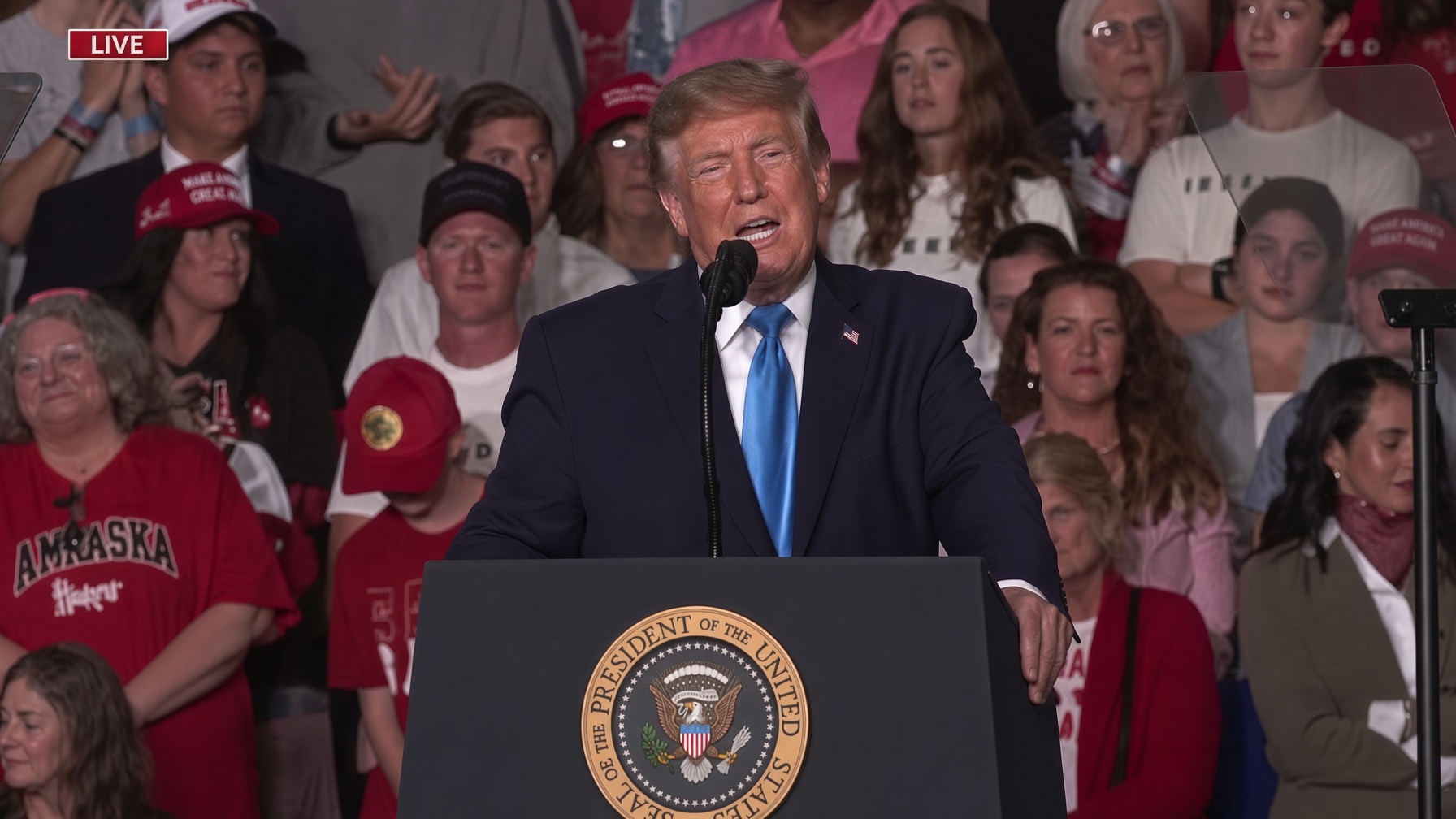
President Donald Trump’s unscripted remarks at a packed campaign rally in Grand Island, Nebraska, on October 5 have triggered one of the sharpest political and public backlashes of his second term, with critics—including California Governor Gavin Newsom—labeling the comments “unhinged and dangerous” and some voices going further to accuse the president of effectively inviting catastrophe on American soil.
Speaking about the ongoing U.S. military campaign against Iran and the resulting pressure on energy prices, Trump told supporters that higher gasoline costs were “just artificial” and “a little bit high,” adding that they represented “a small price to pay for keeping the world safe, keeping our country safe.” He then continued: “They can take out a city. Let them take, let them take out Los Angeles; let them take out San Diego. That’s—this is a very small price to pay, and it’s going to be over with very soon.”
The audience cheered the California references. Within hours the clip spread widely, prompting immediate condemnation from Democratic officials, some Republicans, and segments of the public who interpreted the language as treating the destruction of two major American cities—home to more than 10 million people and critical military infrastructure—as acceptable collateral in the Iran conflict. Social media filled with accusations of treason, reckless endangerment, and a willingness to sacrifice coastal California for geopolitical or economic aims. Many residents in the two cities expressed fear that Iranian forces or proxies might view the president’s words as an invitation or signal of reduced U.S. resolve to defend them.
Governor Newsom responded forcefully, calling Trump “deranged and dangerous” and directing California’s State Threat Assessment Center to heighten monitoring “in the event that foreign actors interpret the president’s remarks as an invitation to target California.” He described the comments as “dangerous—if not treasonous,” noting that they put “a target on two of our biggest cities and one of America’s largest naval hubs.” Los Angeles Mayor Karen Bass and San Diego Mayor Todd Gloria joined the criticism, rejecting any suggestion that their cities should be viewed as expendable.
The White House moved quickly to push back. Communications Director Steven Cheung stated that the remarks were being distorted and that Trump “was clearly stating U.S. cities would have been threatened if a nuclear Iran hadn’t been stopped.” The administration emphasized that the campaign has left Iran without a nuclear capability, navy, or air force, and that America is safer as a result. Trump himself later clarified on Truth Social that he had been drawing a comparison: a temporary increase in gasoline prices was a small price relative to the far greater disaster that would occur if Iran ever bombed San Diego or Los Angeles. He reiterated that the United States would not allow such an attack and that he loves both cities.
Fact-checkers and subsequent reporting noted that Trump’s full context linked the “small price” language primarily to energy costs and the broader strategic goal of preventing a nuclear-armed Iran from threatening American cities. Critics, however, argue that the phrasing was reckless regardless of intent, especially given the president’s history of sharp criticism of California and the elevated public anxiety surrounding the Iran conflict. The episode has intensified debate over wartime messaging, the reliability of presidential rhetoric under pressure, and the political risks of treating major American population centers as rhetorical examples in discussions of military sacrifice. With midterm elections approaching, the controversy continues to dominate cable news cycles and social platforms, underscoring deep partisan divides over both the Iran war and the president’s communication style.