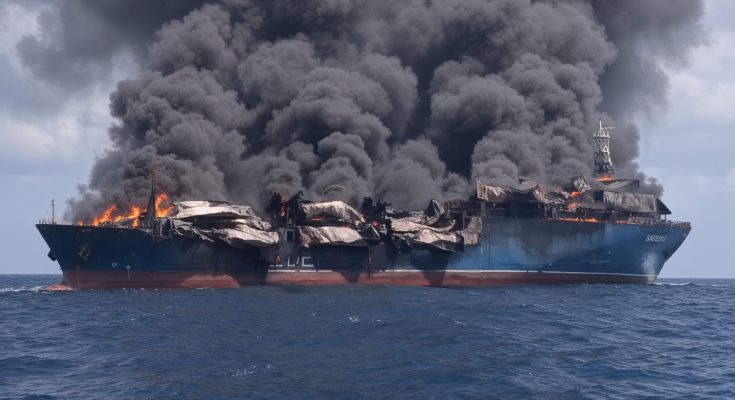
DUBAI — Strategic waterways across the Middle East were pushed closer to the brink on Friday following reports that an Iranian strike targeted a Singapore-flagged commercial vessel, triggering alarms across global energy markets and maritime security agencies.
Details regarding the precise nature of the strike remain closely held. Maritime authorities and naval watchdogs have yet to issue a comprehensive battle-damage assessment, verify whether the vessel sustained hull breaches, or confirm casualties among the crew. Nevertheless, the incident has reverberated through international shipping boardrooms, prompting emergency security reassessments across the sector.
Tehran Issues Veiled Ultimatum to Merchant Fleets
In the immediate wake of the strike, military officials in Tehran broadcast a sharp maritime advisory warning commercial carriers to avoid operating near zones designated for Iranian military operations.
“Stay out of our routes… you alone will bear the responsibility,” the warning stated, according to maritime intelligence feeds and regional monitors.
The blunt directive signals a troubling escalation for commercial shipping. By effectively declaring ad-hoc exclusion zones across vital transit corridors, Tehran has placed civilian merchantmen squarely within the operational crosshairs of regional hostilities. Naval analysts warn that ambiguous military advisories strip commercial traffic of predictable safeguards, leaving merchant crews uniquely vulnerable to misidentification or deliberate interdiction.
Critical Chokepoint in the Crosshairs
The attack focuses international scrutiny on the Strait of Hormuz and the Gulf of Oman—narrow, contested channels through which roughly one-fifth of the world’s petroleum consumption transits daily.
Because the Strait serves as the primary artery linking Persian Gulf oil producers to refineries worldwide, even minor operational friction carries immediate global ramifications. The prospect of prolonged kinetic action in these waters threatens to roil crude futures, trigger sharp spikes in bunker fuel costs, and disrupt fragile manufacturing supply chains.
The economic fallout is already materializing in the commercial maritime sector:
-
War-Risk Insurance Premiums: Underwriters are moving swiftly to adjust coverage rates for tonnage transiting the Gulf, significantly driving up the baseline cost of moving cargo.
-
Costly Route Diversions: Major carrier syndicates are weighing the logistics of rerouting vessels away from high-threat zones. Opting for longer detours—such as circumnavigating Africa’s Cape of Good Hope—substantially increases voyage duration, fuel burn, and carbon expenditure.
-
Operational Gridlock: Port calls and scheduled transits face widespread delays as shipmasters hold positions in safer waters awaiting security clearances.
International Scrutiny and Naval Deployments
In Singapore, home to one of the world’s preeminent ship registries, maritime and port authorities are coordinating with regional allies to establish the operational facts of the strike. Investigators are working to confirm the weapon type employed—whether an unmanned aerial vehicle (UAV), fast-attack craft, or cruise missile—and determine whether the vessel was singled out or caught in broader perimeter fire.
Diplomatic pressure is mounting on Western and regional naval coalitions to reinforce existing maritime security architecture. Multilateral task forces may soon face demands to broaden escort duties, ramp up aerial surveillance, and establish fortified transit lanes to deter further strikes.
Industry groups are advising all commercial tonnage in the region to maintain high-alert protocols, conduct continuous radar sweeps, disable automated identification systems only under official naval guidance, and sustain direct communications with regional maritime liaison offices. With global energy security intimately bound to the safety of these sea lanes, market watchers remain on edge, awaiting proof of whether this strike marks an isolated confrontation or the opening salvo of a broader maritime offensive.