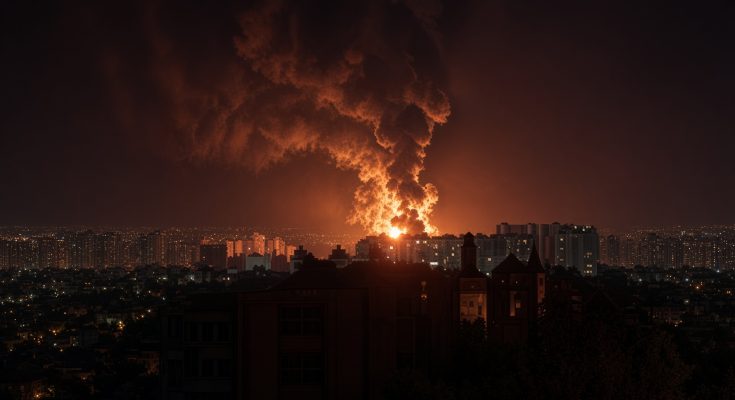
BUCHAREST — Romania scrambled two F-16 fighter jets after a small maritime drone was found drifting a few hundred meters from the Neptun Alpha platform, part of the Neptun Deep natural-gas project in the Black Sea.
A commercial vessel reported the object at about 6:28 a.m. local time on August 20, inside Romania’s exclusive economic zone and roughly 80 nautical miles east of Constanța. Hundreds of workers were on site. Officials treated the sighting as an immediate threat to people and critical energy infrastructure.
Two Romanian Air Force F-16s were sent to investigate. One aircraft opened fire with its onboard cannon, striking the drone but not destroying it. The damaged vessel continued to drift. A Coast Guard ship then arrived with an explosive-ordnance disposal team from the Naval Forces. Specialists inspected the wreckage and neutralized it. Tracking data from the jets and reports from the responding crew later confirmed that only one drone was involved. No casualties and no damage to Neptun Deep facilities were reported.
Defense Minister Radu Miruță said the order to destroy the drone was issued to protect workers on the platform and to secure the site. He later said the device was carrying an explosive charge. Through a direct channel with Kyiv, Romanian officials asked whether the drone was Ukrainian. Ukraine said it was not. The origin has not been independently established. President Nicușor Dan publicly blamed Russia and called the episode part of an intensification of “irresponsible incidents,” while stressing coordination with NATO allies.
The episode fits a wider pattern of security pressure in the Black Sea since Russia’s war against Ukraine. Romanian authorities had already recovered drone debris near Neptun Alpha days earlier, after another commercial vessel reported wreckage about 83 nautical miles east of Constanța. On August 11, navy divers destroyed two drifting Gerbera-type aerial drones in the same project area. Officials say those systems were also not Ukrainian.
Neptun Deep, developed by OMV Petrom and Romgaz, is one of Europe’s most closely watched offshore energy projects. First production is planned for 2027. If it comes online as scheduled, Romania is expected to become the European Union’s largest natural-gas producer. That status has made the field a strategic asset — and, officials argue, a more tempting target. NATO partners have previously raised the need to protect the site from drone threats. European Commission President Ursula von der Leyen described the August 20 incident as part of an “escalating campaign of threats.”
For Bucharest, the morning sequence was a test of speed more than firepower: an unidentified object at sea, a decision to use fighter jets, a cannon strike that disabled but did not finish the target, and a controlled neutralization by specialists at the scene. The drone was removed without injury. The explosives found aboard, and the proximity to an active platform, have sharpened concern that offshore energy infrastructure in the western Black Sea is now part of the conflict’s gray zone — close enough to matter, and still hard to defend at all hours.