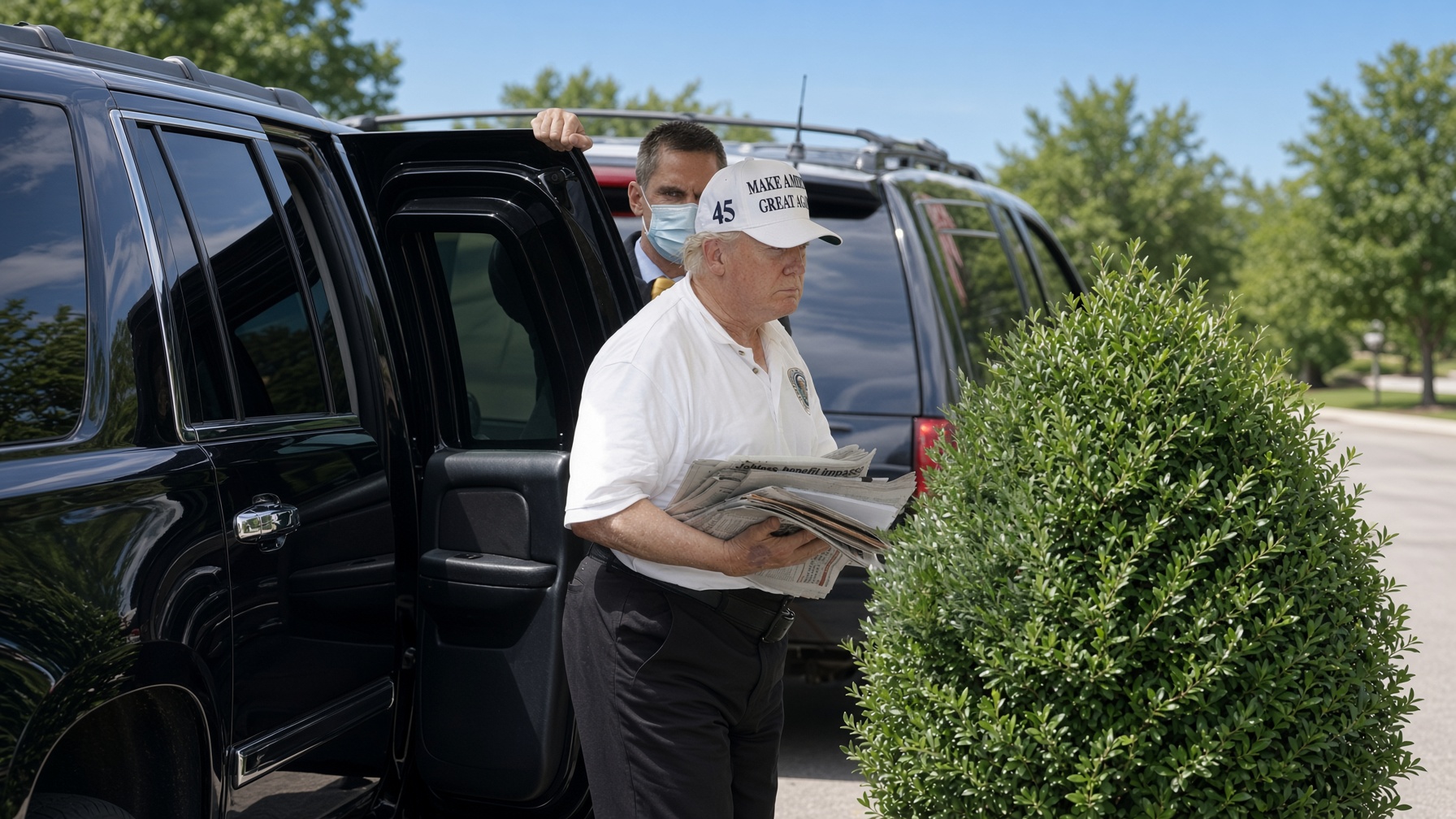
NATIONAL — A reported late-night sighting of President Donald Trump set off a burst of online speculation after posts said he had been seen walking alone just after midnight, in a baseball cap and without the usual motorcade, cameras or public notice. Some accounts focused on a small object said to be in his hand and to have caught the light under streetlamps.
Those details have not been independently confirmed by major news organizations, the White House or the Secret Service. No official itinerary, pool report or named witness has established the time, place or what—if anything—was in his hand. In the gap, interpretation raced ahead of evidence.
Some users treated the object as significant. Others cast the walk itself as a clue: illness, a secret meeting, a stunt, a body double. None of those readings rest on verified reporting. What is documented is the reaction. Grainy clips and secondhand captions were enough to launch a national conversation about a scene that may have been ordinary, misidentified or not Trump at all.
Presidents rarely move in public without a protective detail. That is why a lone-walk claim is inherently unusual—and why it should be checked before it is treated as news. A baseball cap is not unusual for Trump; he has worn one at official events, including high-profile appearances in 2026. A reflecting object at night can be a phone, keys, a watch face or a trick of a lamp. Without a clear still and a confirmed time stamp, it is not a finding.
The episode is a familiar pattern. Incomplete images of public figures attract projections. Supporters and critics load the same blur with opposite meanings. A quiet walk becomes “content.” Curiosity hardens into a theory. The subject of the photo matters less than the assumptions of the people watching it.
Recent days have already shown how quickly appearance chatter attaches to Trump. Commentators parsed his gait after an early return from Camp David and argued over a shape under a jacket in other footage. Those debates, too, mixed observation with guesswork. A midnight sighting with no official confirmation sits even further down the evidence scale.
Newsrooms generally wait for pool photographers, local police or the White House to corroborate a presidential movement after dark. Social media does not. Posts accumulate views before anyone can say where the video was shot or whether the person in the cap is who the caption says.
Not every unanswered detail hides a plot. Sometimes a person is walking. Sometimes a clip is old, mislabeled or of someone else. Uncertainty is allowed to stay uncertainty.
Until officials or on-the-record witnesses confirm a midnight solo walk and identify the object, the responsible account is narrow: claims circulated, facts did not keep up, and the story that spread was mainly about how fast an unverified image can become a narrative. The larger lesson is not what glittered under a streetlamp. It is how little proof it takes for the public to decide it already knows.