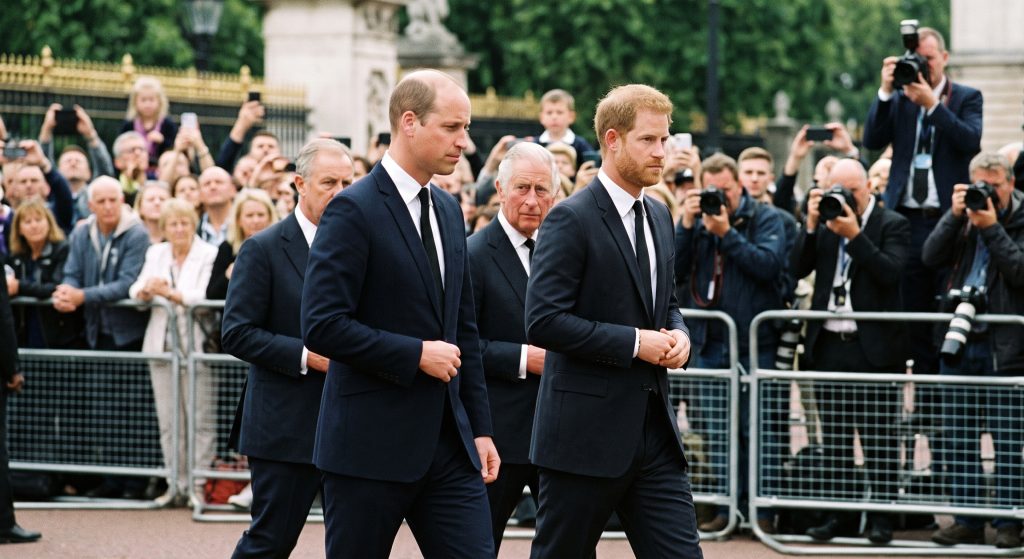
LONDON — More than two decades have passed, and yet, the death of Princess Diana remains an incandescent failure point in the history of the British royal family. For the public, it is a defining moment. For Princes William and Harry, it is not a historic event witnessed by millions, but the annihilation of their mother during childhood, an agonizing loss that continues to pull at the architecture of the monarchy and their shared personal future.
The current wave of public fascination and reported family conflict has once again thrust those unresolved memories into stark focus, demanding that an institution built on continuity reckon with a history it has never successfully buried.
Claims are now circulating in royal-focused publications describing an alleged private conversation between King Charles and Prince William, framing it as an emotional reckoning and a moment of rare paternal confession. However, there is no reliable public confirmation of the specific dialogue described in these speculative reports. Private royal discussions are, by their nature, difficult to verify independently, and claims attributed to anonymous sources should be treated with significant professional caution.
What is firmly documented is that the circumstances surrounding Diana’s death on August 31, 1997, and the unparalleled public funeral that followed, continue to generate controversy and competing accounts. For a 15-year-old William and a 12-year-old Harry, that global funeral march was an intensely personal loss unfolding under a global telescope. It was an experience that bonded the brothers but also set their subsequent, vastly divergent paths in motion.
While William has remained a loyal lieutenant of the institution that is his destiny, eventually becoming the Prince of Wales and heir, Harry stepped away from all official duties with his wife, the Duchess of Sussex, and established a new life in the United States. Those decisions created a wider family rift that now seems intractable.
Contested Memories and Palace Rebuttals
This latest controversy arrives as Diana’s brother, Charles Spencer, has published his poignant memoir, Swan Song: Diana, My Sister. The book has reopened raw questions about the family’s response to her death. Spencer made a series of claims about conversations with royal figures following the accident, including a disturbing allegation that then-Prince Charles told him, “we’ll forget her soon enough.” Spencer has defended his recollection, stating he believes he is accurately describing what occurred.
Buckingham Palace, in an unusually direct and public response, has disputed the account. A statement suggested that grief can affect judgment and memory—an unprecedented public comment on a personal family dispute from a household that traditionally maintains a policy of dignified silence. This unusual move by King Charles’s team only highlights how raw and unsettled the memories of Diana remain nearly three decades later.
Duty vs. Personal Landscape
For Prince William, the situation is uniquely complicated. His position as future king forces him to operate within the same institution that was central to the circumstances of his childhood. He can have a relationship with his father while also carrying the trauma of his parents’ spectacular marital failure and his mother’s subsequent death.
He must reconcile the demands of duty with memories that no title or act of public service can erase. There is no evidence that a single private conversation with his father has resolved these profound tensions.
Harry’s Presence as a Constant Reminder
Prince Harry, too, remains a key figure in this intractable story. His decision to speak publicly about his grief, his challenges within the royal family, and his complex relationship with his brother has added new layers of public scrutiny. While Charles confirmed in September that Harry and Meghan remain private, non-working members of the royal family, and will not use their HRH styles, their recent returns to Britain have only served to renew public interest in these deeply fractured relationships.
The ongoing interest in Diana’s story reveals a fundamental truth: institutions may move forward, but families do not necessarily. The titles have changed, a new generation has taken the throne, and the monarchy itself has entered a new era. Yet, for William and Harry, Diana will always be more than a historical figure or a symbol of national mourning. She was their mother. And her absence remains one of the central facts around which the modern history of the royal family continues to unfold.