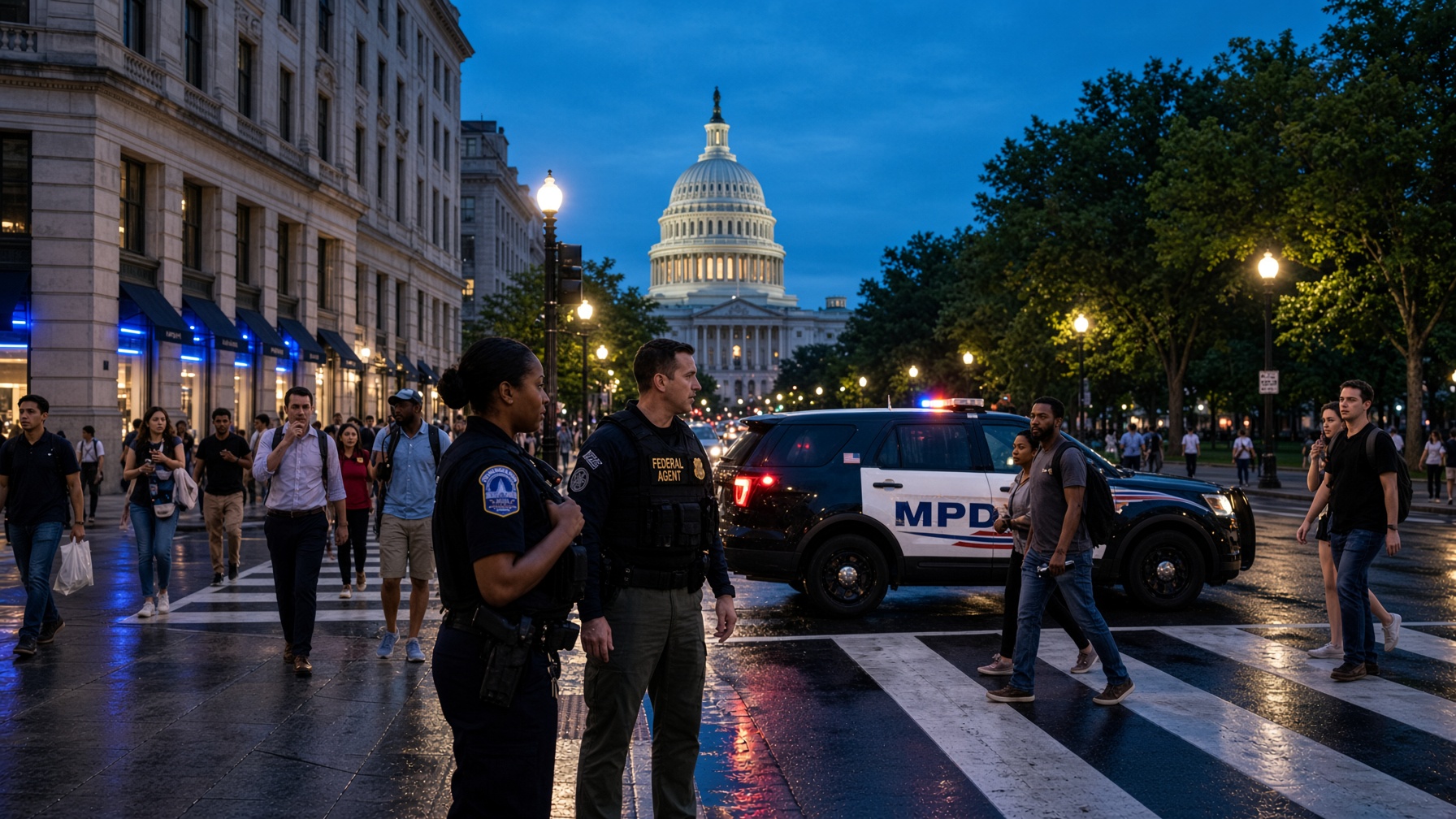
WASHINGTON — The Trump administration has widened the federal footprint in the nation’s capital, arguing that Washington requires a centralized answer to violent crime. Multiple federal agencies now work in explicit operational roles alongside Metropolitan Police officers, coordinated through the D.C. Safe and Beautiful Task Force.
The operation has tightened enforcement of federal firearms statutes and quality-of-life offenses in a city over which Congress already holds unusual constitutional authority. Officials say the aims are fewer violent crimes, more prosecutions and a stronger sense of public order. The result has polarized neighborhoods and revived an old argument: who actually governs the District.
**Safety vs. sovereignty**
For some residents in areas long marked by gunfire and open-air drug markets, the surge is visible and welcome. People who spoke to reporters have described more patrols, fewer carjackings and a sense that serious offenders are being taken off the street. Supporters call it a delayed application of federal resources in the seat of government.
The administration points to sharp drops in several categories. Justice Department figures released around the task force’s first anniversary cited large year-over-year declines in homicides, robberies and vehicle thefts. ATF said the task force had surpassed 2,000 firearm recoveries by September 2026, with more than 17,000 arrests since the August 2025 surge, including homicide, firearms and narcotics cases. Missing children have also been recovered.
Community advocates and civil-rights groups offer a different reading. They call the heavier federal presence an infringement on local self-government and say it has deepened anxiety, especially in immigrant communities. Critics argue that multiple agencies with different missions and use-of-force rules operating on the same streets make accountability harder. They say the initiative blurs the line between federal and municipal policing and strains the District’s Home Rule Charter.
**A constitutional argument, not only a crime argument**
Legal scholars note that Congress never surrendered plenary authority over the capital, even after the city gained an elected mayor and council. The fight is therefore not only about statistics. It is about who sets local policing priorities, how federal and city officers should interact when jurisdictions overlap, and how far an administration can go before Home Rule looks optional.
An administration official, speaking on condition of anonymity, said the first duty of government is public safety and that the focus is criminal activity, not peaceful civic life. District leaders have questioned whether saturation by outside agencies can last. MPD Chief Pamela Smith has acknowledged tactical cooperation while stressing that her department answers to District residents.
Courts and jails have felt the volume. Prosecutions in D.C. Superior Court rose sharply over the past year, and city judges have described dockets under strain. National Guard troops remain part of the broader presence.
The test ahead is the same one officials, residents and advocates keep repeating: whether Washington can stay safer without weakening oversight, eroding civil liberties, or treating the city’s claim to govern itself as a privilege that can be withdrawn.