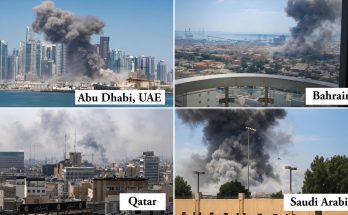
WASHINGTON — A direct military showdown between the United States and Iran escalated sharply after the Islamic Revolutionary Guard Corps (IRGC) fired a barrage of ballistic missiles targeting American installations across the Middle East, precipitating joint U.S.-Saudi airstrikes in Iraq and sweeping retaliatory strikes directly onto Iranian soil.
According to operational briefings from U.S. Central Command (CENTCOM), layered regional air defenses—including Patriot and THAAD interceptor batteries—successfully intercepted all incoming Iranian missiles launched during the attempted surprise assault, preventing casualties among the more than 50,000 U.S. personnel deployed across the theater on maximum alert.
The engagement triggered an immediate, multi-theater counteroffensive that fundamentally widened the operational boundaries of the confrontation.
Bilateral Sorties in Eastern Iraq
Hours after the missile attack was repelled, U.S. combat aircraft joined Royal Saudi Air Force fighters in conducting precision airstrikes against logistics depots, weapons caches, and operational staging areas operated by Iran-aligned militias in eastern Iraq.
CENTCOM indicated that the targeted militia nodes were operating under direct IRGC command and had orchestrated sustained strikes against allied personnel and critical Saudi energy infrastructure, including more than 30 unmanned aerial attacks launched in the preceding 72 hours alone. The bilateral mission underscored a deepening operational alignment between Washington and Riyadh, following recurring drone incursions against Saudi hydrocarbon arteries, including key pumping stations along the Kingdom’s East-West pipeline corridor.
Pentagon assessments revealed that Iran-aligned militias had attempted over 600 strikes against American personnel, diplomatic missions, and military sites between February and April 2026, illustrating the intense operational pressure confronting forward-deployed forces along the northern Gulf arc.
Retaliatory Blows Inside Mainland Iran
Washington’s kinetic response culminated in a massive, theater-wide air campaign striking dozens of strategic IRGC infrastructure targets across mainland Iran.
Pentagon officials confirmed that the retaliatory sorties struck hardened subterranean missile storage facilities, drone fabrication and assembly plants, coastal radar sites, command-and-control complexes, and naval logistics centers. Defense planners characterized the operation as a decisive measure to degrade Tehran’s capability to disrupt international commercial shipping along the Strait of Hormuz, conduct asymmetric strikes against Gulf partners, or threaten forward American contingents.
The strikes followed earlier operations that neutralized Iranian coastal surveillance networks and IRGC Navy fast-attack craft along the Persian Gulf.
An Expanding Battlespace
The rapid escalation highlights the dangerously interconnected nature of the regional theater, where an initial launch from sovereign Iranian territory precipitated cross-border coalition strikes in Iraq, rapidly followed by direct bombardments on Iranian soil.
The active battlespace now encompasses an integrated corridor linking the Persian Gulf, central Iraq, Yemen, the Red Sea, and the Strait of Hormuz. With commercial shipping routes under constant threat from coastal batteries and suicide drones, multinational naval assets remain engaged in continuous escort operations to safeguard global energy transit.
As regional air defense systems remain locked on maximum readiness and diplomatic off-ramps continue to narrow, the exchanges underscore the heightened risk that isolated skirmishes could metastasize into an uncontrolled regional war spanning multiple borders.